
Accounting for insurance claim proceeds on a rental property takes two steps: record the casualty loss when the damage happens, then record the expected recovery as a receivable rather than income. The gap between the two is your real loss. Here is how Real Estate Accounting professionals book each piece.
By REA Team, Property Management Experts

What Is the Right Way of Accounting for Insurance Claim Proceeds After a Rental Property Loss?
An insurance claim is a formal request to your insurance company to pay for covered damages under one of your insurance policies. The payment is called insurance proceeds. Premiums you pay for the policy are an ordinary operating expense and stay out of these entries.
Under GAAP, the standard U.S. rulebook for financial statements, you treat the loss and the recovery as two separate transactions. First you write off the damaged component and book the casualty loss. Then you record the recovery once it is probable, and you clear it when cash arrives. Netting both into one deposit hides the loss.
Each entity that owns a property books its own claim, so a single-property LLC keeps its loss, receivable and settlements in its own ledger. Many properties also carry several insurances at once: property, loss-of-rent and liability cover. Each responds to a different part of the loss.
| Claim type | What it covers | Where it lands | |---|---|---| | Property damage | Building, fixtures, equipment, inventory such as furnishings and supplies | Write off the damaged part, book the casualty loss, offset with the recovery | | Repairs and cleanup | Emergency work and rebuilding costs | Repairs expense, offset by the reimbursement | | Lost rent (business interruption) | Rent you could not collect while units were down | Rental income, recorded when the payment is realized or settled | | Liability claims | Damages owed after a tenant or visitor injury | Liabilities and expense, with the insurer's share as a recovery |
How Do You Book the Casualty Loss on a Rental Property?
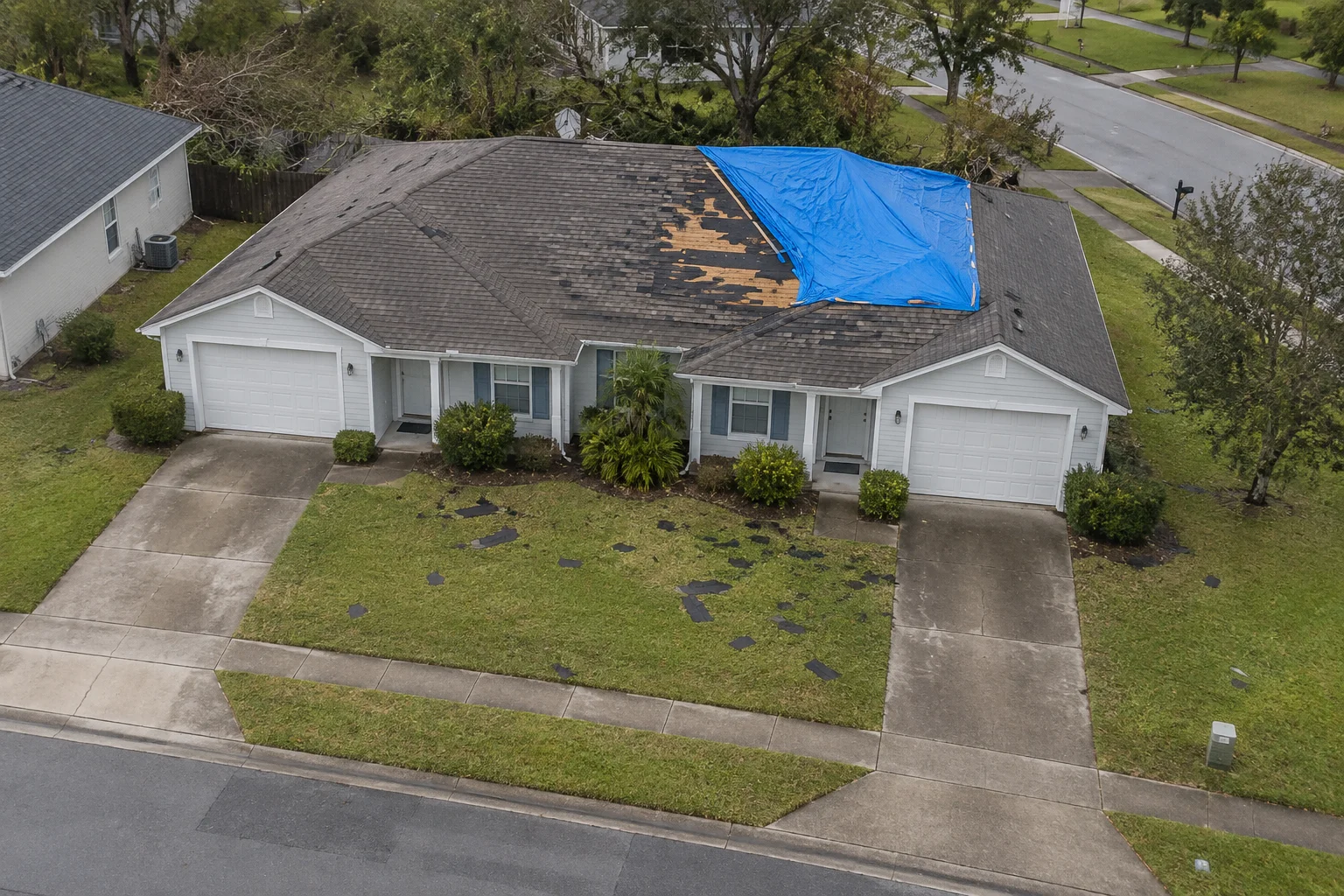
A casualty is sudden, unexpected damage such as fire, storm or flood. You book casualty losses on the date the damage occurs, not on the day the insurer pays, and you measure them against book value (original cost minus accumulated depreciation), not the cost to rebuild.
1. Identify the damaged component, such as a roof, a unit's flooring or a whole building, and list any damaged inventory, such as appliances, furnishings or maintenance supplies. 2. Pull its cost and accumulated depreciation from the depreciation schedule. 3. Remove both from the books and debit the difference to casualty loss. 4. Expense emergency costs, such as water extraction or boarding up, in the same period, and record unpaid invoices as liabilities.
Here is a running example. A storm destroys a roof with a cost of $60,000 and accumulated depreciation of $24,000, so its book value is $36,000. Cleanup costs $4,000. The entries are:
- Debit accumulated depreciation $24,000
- Debit casualty loss $36,000
- Credit building improvements $60,000
- Debit casualty loss $4,000 and credit cash $4,000
Repairs that restore the roof to its prior condition go to repairs expense. A full replacement that extends the roof's useful life is capitalized as a new component at its own cost, and the insurance proceeds never reduce that new cost.
What Is an Insurance Recovery Receivable and When Do You Record It?
An insurance recovery receivable is a short-term asset that shows the money your insurer owes you for a loss you already booked. It sits on the balance sheet until the claim pays, then clears to cash. Book it in the entity that holds both the policy and the property. Booking it keeps the casualty loss and its offset in the same period, so the income statement shows only what you will actually bear.
When Can You Record an Insurance Recovery Receivable Before the Claim Is Paid?
You can record it once recovery is probable, meaning likely to happen. Good evidence includes written confirmation that the insurer accepts its obligation to pay, an adjuster's estimate of the damages and no open dispute over the policy provisions that apply. Cap the receivable at the loss you have recognized, which protects you from booking a gain early. Anything above that is a gain contingency under ASC 450-30, and GAAP holds it back until the settlements are final.
Back to the roof. The insurer confirms in writing that it will pay $35,000 after a $5,000 deductible, the amount you bear before coverage starts. You debit the insurance recovery receivable $35,000 and credit casualty loss recovery $35,000. The income statement now shows a net loss of $5,000, which equals the deductible. If the insurer denies the claim or reserves its rights, record no receivable, keep the full loss and disclose the open claim in the notes.
How Do You Record the Insurance Payout When the Claim Is Settled?
Accounting for insurance claim proceeds at settlement comes down to one entry: debit cash and credit the insurance recovery receivable. For the roof, you deposit the $35,000 check and clear the receivable, which leaves the net loss unchanged. If the final settlement differs from the receivable, the difference moves the casualty loss line up or down. If the insurer pays in partial settlements, clear the receivable by each amount received.
Gain or Loss When Proceeds Differ From the Asset's Book Value
Compare what the insurer pays with the damaged item's book value. This table ignores cleanup costs to keep each scenario simple.
| Scenario | Proceeds vs. $36,000 book value | Result | |---|---|---| | Below book value | $30,000 | Net casualty loss of $6,000 | | Equal to book value | $36,000 | No gain or loss | | Above book value | $50,000 | Gain of $14,000, recognized once the amount is settled |
GAAP recognizes gains only when they are realized, so a $50,000 estimate the insurer has not agreed to stays off the books.
Repairs, Lost Rent and the Deductible
Here is how to account for insurance proceeds when one check covers several things: split it before posting, using the specifics of the adjuster's payment breakdown. When several insurances paid on the same loss, post each one's share to its own line. The reimbursement for repairs offsets repairs expense. The building portion clears the receivable. Lost rent goes to rental income when the payment is realized, because it replaces income the damages kept you from earning. The deductible stays as expense, since it is the part of the loss nobody reimburses.
Is It Income or a Reduction of the Loss?
Under GAAP, recovery of a loss reduces the loss. It is not income. Only lost rent and any excess over the recognized loss count as income or gains. Posting a building-damage check to revenue overstates net operating income (NOI), the figure lenders and buyers use to value the property.
Are Insurance Claim Proceeds on a Rental Property Taxable?
Tax treatment differs from the books, and the specifics depend on the property and the year. These are the general rules from IRS Publication 547, Casualties, Disasters, and Thefts:
- Proceeds up to the property's adjusted basis (cost minus depreciation taken) are generally not taxable, because they reimburse a loss.
- Proceeds above adjusted basis create a taxable gain. You may be able to postpone it by buying replacement property within the replacement period.
- Payments for lost rent are generally taxable income because they replace rent.
- A casualty loss on a rental property is the lesser of adjusted basis or the drop in fair market value, minus insurance reimbursement from all of your insurances. The $100 and 10 percent of adjusted gross income limits apply to personal-use property, not rental property.
- If you have a reasonable prospect of reimbursement, you generally cannot deduct that part until you know whether it will arrive.
- Insurance premiums for rental property are generally deductible as ordinary rental expenses, so they stay out of the casualty calculation.
A federally declared disaster adds options, such as claiming the loss on the prior year's return, and the IRS often extends deadlines after a declared disaster. Our Income Tax Services team of tax professionals can help reconcile the book entries to your return.
Common Questions About Rental Property Insurance Claims
How do you classify insurance proceeds in QuickBooks?
Classify property-damage proceeds against the loss, not income. Use an other current asset account named Insurance Recovery Receivable while the claim is open, and a casualty loss recovery account for the offset. Reserve an income account for lost-rent payments only.
How do you record an insurance claim check in QuickBooks?
Create a deposit and select the Insurance Recovery Receivable account if you accrued the claim. If you did not, select the casualty loss recovery account instead. Never pick an income account for property-damage money.
Is business interruption money rental income?
Generally yes. Business interruption (loss-of-rent) payments replace rent you could not collect, so they belong in rental income, recorded when the amount is settled or the payment is realized.
Get Your Casualty Claim Booked Correctly
REA's 230+ property accountants support 130,000+ residential units and 30M+ commercial square feet. To have your claim booked correctly from loss to settlement, schedule a time with us.
Want this handled for you?
Schedule a Call