
Table of Contents
- What Is a Chart of Accounts and Why Does It Matter for Rental Property?
- Standard Account Number Structure
- Complete Chart of Accounts Example for Rental Property
- Assets (1000s)
- Liabilities (2000s)
- Revenue (4000s)
- Operating Expenses (5000s)
- Common Chart of Accounts Mistakes for Rental Property Owners
- Chart of Accounts for Commercial vs. Residential Rental Properties
- How REA Sets Up and Maintains Rental Property Charts of Accounts
- Frequently Asked Questions

A chart of accounts for rental property is the numbered master list of every account your business uses to record financial transactions. It is the backbone of your accounting system. Get it right from the start and your financial statements are clean, your tax returns are accurate, and your property-level reporting is actionable. Get it wrong and you spend years untangling misclassified expenses and consolidated accounts that obscure true performance.
By REA Team, Property Management Experts | Published April 21, 2026
What Is a Chart of Accounts and Why Does It Matter for Rental Property?
A chart of accounts is a structured index of every account category your business uses to classify financial activity. It is organized into five main categories: assets, liabilities, equity, revenue, and expenses. Every transaction in your property management business, from collecting rent to paying a vendor to recording depreciation, is posted to one of these accounts.
For rental property owners and property managers, a well-designed chart of accounts serves several functions beyond basic bookkeeping. It enables property-level profit and loss reporting, supports accurate tax classification, satisfies lender reporting requirements, and provides the data foundation for cash flow forecasting. Software platforms like AppFolio, Yardi, Buildium, Rent Manager, Entrata, and QuickBooks all operate on a chart of accounts structure. The account numbering and naming conventions you establish in the system shape everything that flows through it.
The structure matters because real estate accounting has unique requirements. Rental income must be tracked separately from late fee income and other ancillary revenue. Security deposits must be kept off the income statement entirely and recorded as a liability. Capital expenditures must be distinguished from operating expenses. Depreciation is a non-cash expense that requires its own account category. A generic small-business chart of accounts typically does not address any of these correctly.
Standard Account Number Structure
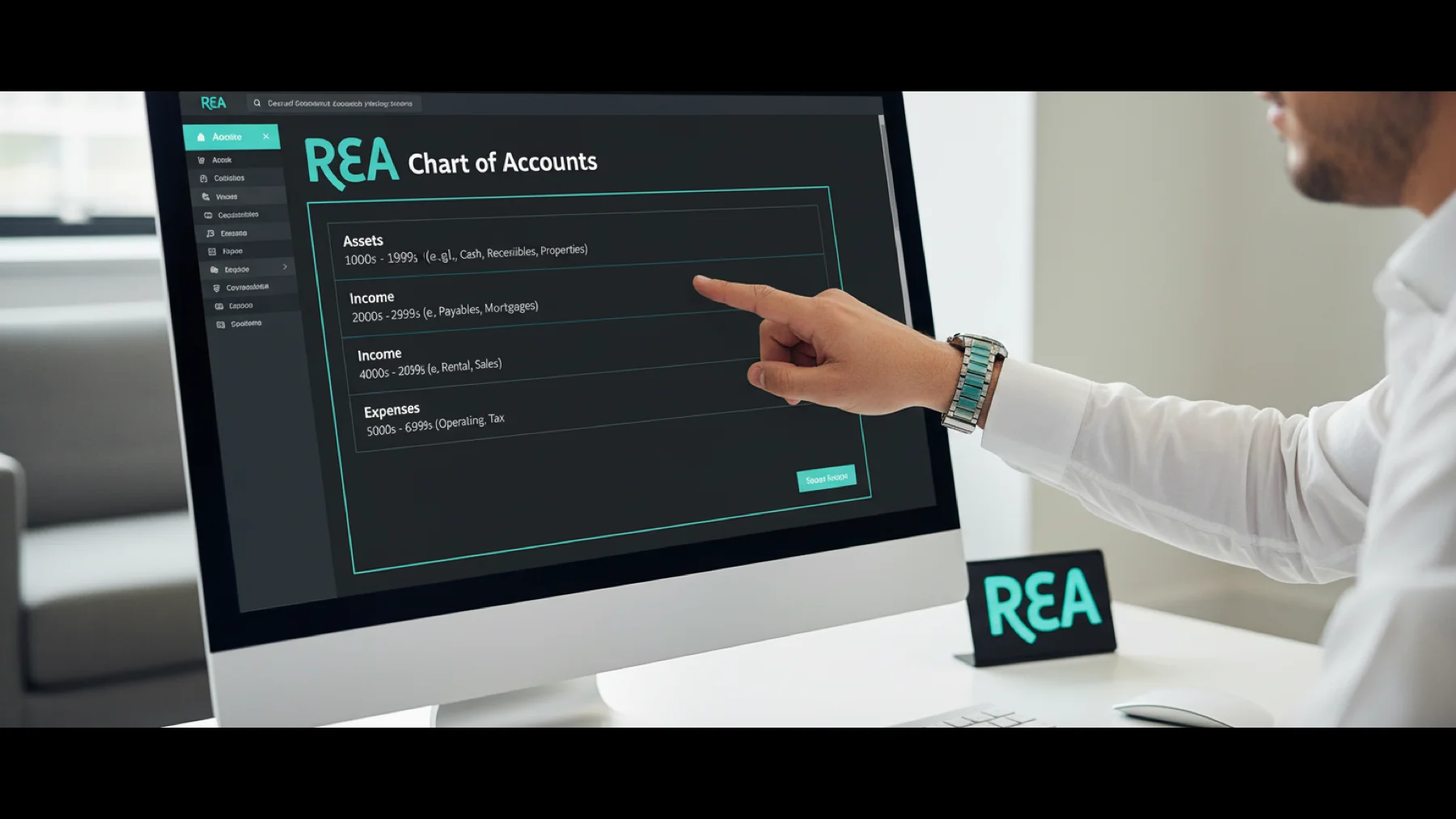
Most property management accounting systems use a four to five digit numbering convention organized by account type. Here is the standard framework:
Complete Chart of Accounts Example for Rental Property
The following is a working example chart of accounts structured for a residential rental property business. It can be adapted for commercial portfolios by adding lease-specific accounts and expanding the revenue section.
Assets (1000s)
Liabilities (2000s)
Revenue (4000s)
Operating Expenses (5000s)
Common Chart of Accounts Mistakes for Rental Property Owners
Treating security deposits as income. Security deposits are a liability until conditions are met for their application or return. Recording them as revenue overstates income and creates tax problems. Every platform used in property management, including QuickBooks for real estate, has a specific account type for security deposit liabilities. Use it.
Using a single catch-all expense account. Combining repairs, maintenance, capital improvements, and management fees into one account destroys your ability to analyze costs by category. It also creates tax issues because capital improvements are depreciated, not expensed, while routine repairs are deductible immediately. These must be separate accounts.
Not separating property-level accounts. For a multi-property rental property business, each property needs its own set of revenue and expense accounts, or your books need to be structured so that property-level profit and loss reports can be generated on demand. A consolidated income statement showing total revenue across ten properties tells you almost nothing useful about individual asset performance.
Mixing personal and business accounts. Every rental property business, regardless of size, needs clean separation between personal and business accounts. Commingling creates legal exposure, complicates tax preparation, and makes any third-party financial review significantly more difficult.
Misclassifying capital expenses as repairs. Replacing a roof is a capital improvement that gets added to the property's depreciable basis and depreciated over time. Patching a section of the same roof is a repair that is expensed in the current period. The IRS has specific rules, known as the tangible property regulations, that govern this distinction. Misclassification in either direction creates tax risk.
Platform note: Most property management platforms have default chart of accounts templates built in. These are a starting point, not a finished product. The default accounts in AppFolio, Yardi, or Buildium should be customized to match your portfolio structure, entity setup, and reporting needs before you begin entering transactions.
Chart of Accounts for Commercial vs. Residential Rental Properties
Commercial real estate accounting introduces additional complexity. Triple-net (NNN) leases require accounts to track tenant reimbursements for operating expenses separately from base rent. Common area maintenance (CAM) reconciliations need dedicated accounts. Lease incentives and tenant improvement allowances are capitalized, not expensed, and require their own asset accounts.
If you manage both residential and commercial assets, maintaining separate account segments or classes for each property type is strongly recommended. Most institutional-grade platforms support this through class tracking or property-level segmentation. REA's commercial real estate accounting practice works with operators managing these mixed portfolios and can structure the chart of accounts to support both asset types within a single system.
For operators managing property portfolios alongside tax preparation needs, your chart of accounts must also map cleanly to Schedule E for residential rental properties and to the appropriate forms for commercial entities. Clean account structure means faster, more accurate real estate tax preparation every year.
How REA Sets Up and Maintains Rental Property Charts of Accounts
REA's accounting team builds chart of accounts structures within existing property management platforms, reviews and cleans up inherited account setups, and maintains the accounting infrastructure for property managers and investors across the country. Whether you are setting up a new entity for a first acquisition or restructuring the books on a 500-unit portfolio, the chart of accounts work we do upfront prevents years of reclassification headaches downstream.
If your current books have messy, consolidated accounts, untracked receivables, or security deposits sitting in income categories, those problems compound with every transaction you record. Getting the structure right is not an administrative detail. It is the foundation that every financial statement, tax return, and investor report is built on.
Connect with REA to review and optimize your rental property chart of accounts.
Frequently Asked Questions
What is a chart of accounts for rental property? A chart of accounts is the master list of every account your rental property business uses to classify financial transactions. It is organized into five categories: assets, liabilities, equity, revenue, and expenses. Every rent payment, repair invoice, mortgage payment, and depreciation entry is posted to a specific account in this structure. The chart of accounts determines how your financial statements are organized and what level of detail they provide.
How many accounts should a rental property chart of accounts have? A single-property landlord may need 30 to 50 accounts. A property management company handling multiple assets across residential and commercial portfolios may maintain 100 or more accounts to support property-level reporting and detailed expense classification. The right number depends on your portfolio complexity, reporting requirements, and the level of operational detail you need to manage the business effectively.
Do I need a separate chart of accounts for each rental property? You do not need a completely separate chart of accounts for each property, but you do need a way to generate property-level financial reports. Most property management platforms accomplish this through class tracking, property IDs, or sub-accounts that allow transactions to be tagged to specific properties while maintaining a unified account structure. Completely separate books for each property creates significant consolidation complexity.
Can I use QuickBooks for rental property accounting? Yes, QuickBooks can be configured for rental property accounting, particularly for smaller portfolios. The chart of accounts setup in QuickBooks requires customization to address real estate-specific needs like security deposit liability accounts, prepaid rent tracking, and property-level class segmentation. Larger portfolios typically benefit from platforms purpose-built for property management. REA works in both environments.
What is the difference between a repair expense and a capital improvement in rental property accounting? A repair restores property to its existing condition and is expensed in the current period. A capital improvement adds value, extends the useful life of the property, or adapts it to a new use, and must be capitalized and depreciated over time. The IRS tangible property regulations provide detailed guidance on this distinction. Misclassifying capital improvements as repairs or vice versa creates tax liability and can trigger issues during an audit.
Want this handled for you?
Schedule a Call