
Table of Contents
- What Property Accounting Services Actually Cover
- The Core Service Areas of Property Accounting
- Financial Reporting
- Bookkeeping and Transaction Management
- Cash Flow and Budgeting
- Tax and Compliance
- In-House vs. Outsourced Property Accounting Services
- Software Platforms That Drive Property Accounting Efficiency
- What Real Estate Investors and Property Managers Should Expect
- Property Accounting in the Commercial Real Estate Context
- When to Move to Outsourced Property Accounting
- How REA Approaches Property Accounting Services
- What REA Delivers
- What You Avoid
- Frequently Asked Questions
- What is included in property accounting services?
- How is real estate property accounting different from regular bookkeeping?
- Do I need separate accounting for each property I own?
- Can outsourced property accounting services work inside my existing software?
- When does accounting outsourcing make financial sense for real estate companies?
- Ready to Get Your Property Books in Order?

Property accounting services handle the financial recordkeeping, reporting, and compliance work behind every real estate portfolio. Whether you own rental properties, manage assets for clients, or operate across commercial and residential holdings, understanding what these services cover and when to bring in outside expertise is one of the most consequential decisions you can make for your business.
What Property Accounting Services Actually Cover
Property accounting is a specialized discipline built around the financial mechanics of real estate ownership. It is not general bookkeeping applied to rental income. The real estate industry has its own lease structures, CAM reconciliation cycles, depreciation methods, trust account rules, and entity reporting requirements. Professionals who focus exclusively on real estate accounting services understand these distinctions in ways that generalist firms typically do not.
At its core, real estate property accounting encompasses:
- Monthly financial statements for each property or legal entity
- Rent roll management tracking occupancy, lease terms, and collections
- Accounts payable and receivable tied to vendors, tenants, and owners
- Bank reconciliations across operating, security deposit, and reserve accounts
- Owner distributions calculated, documented, and delivered each period
- CAM reconciliations for commercial and mixed-use properties
- Cash flow reporting that shows actual liquidity by property and period
- Year-end close and tax-ready package preparation
For investors managing a handful of units, this workload is manageable in-house. Once a portfolio grows past a certain threshold, the time required to maintain accurate books every month becomes a material cost that deserves serious evaluation.
The Core Service Areas of Property Accounting
Financial Reporting
Monthly profit and loss statements, balance sheets, cash flow summaries, and custom owner packets give investors and property managers the data they need to make informed decisions. Accurate financial reporting is the foundation of every other business decision in the real estate industry.
Bookkeeping and Transaction Management
Day-to-day bookkeeping tracks every dollar moving in and out of each property. Rent payments, vendor invoices, maintenance costs, insurance premiums, and capital expenditures are categorized accurately so your books reflect reality at every point in the month.
Cash Flow and Budgeting
Cash management across a property portfolio requires more than tracking deposits. Forecasting reserve needs, timing owner distributions, and planning for capital projects all depend on disciplined cash flow analysis. A dedicated team keeps this data current and actionable.
Tax and Compliance
Real estate tax treatment involves depreciation schedules, cost segregation, passive income rules, and entity-level structuring. Property tax services that coordinate with your accounting team ensure your books support your tax strategy throughout the year, not just at year-end.
In-House vs. Outsourced Property Accounting Services
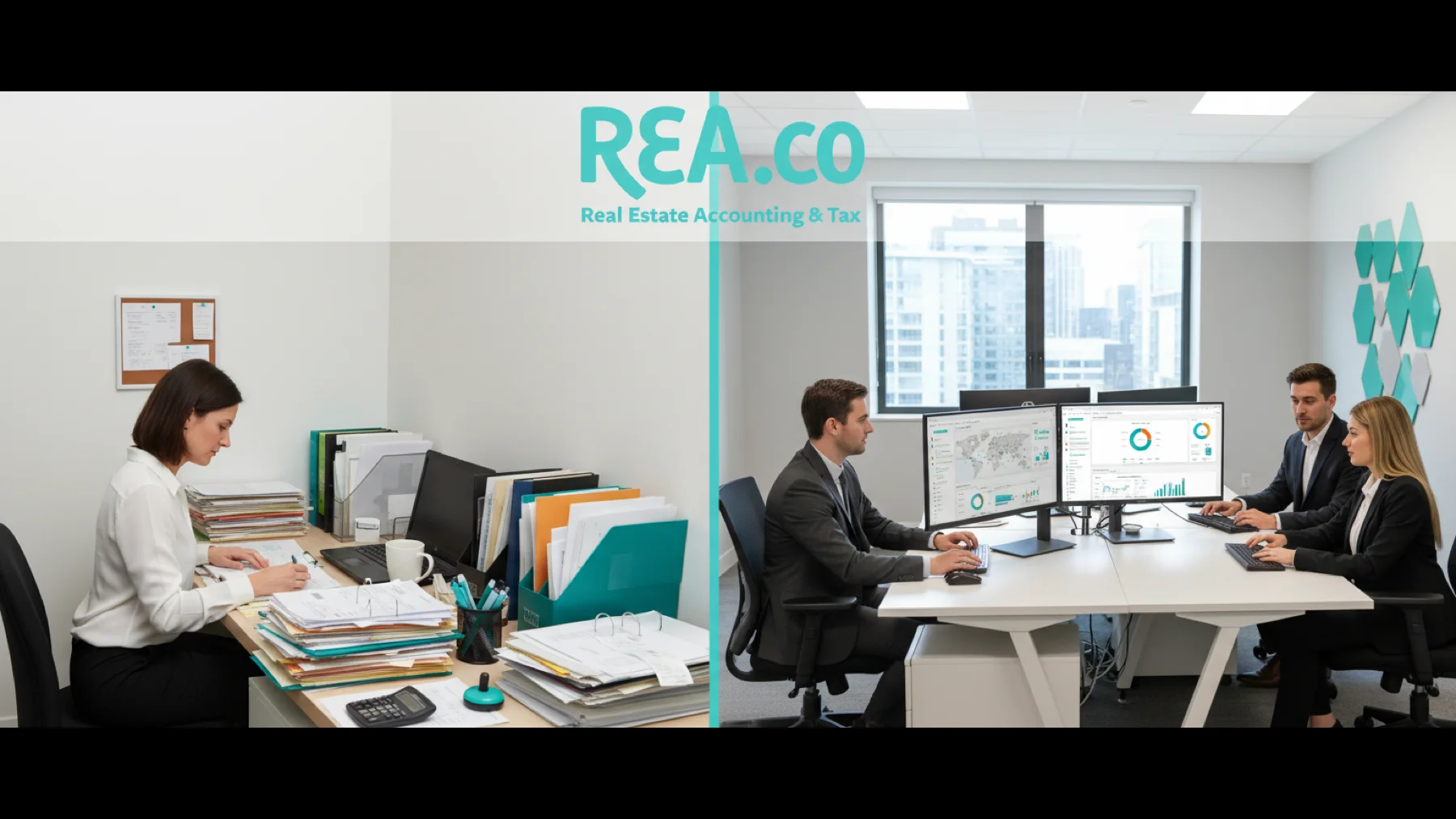
Many property managers and investors start by handling their own books or hiring a part-time bookkeeper. This works at small scale. The challenge is that real estate accounting has enough complexity, particularly around lease compliance, depreciation schedules, and entity-level reporting, that generalists often miss things that create real cost later.
Companies like Gallagher Mohan have built a market around outsourced real estate accounting services, which reflects how much demand exists for specialists in this space. The underlying reason is straightforward: managing accounting outsourcing through a dedicated team removes the single-point-of-failure problem that comes with one internal hire and brings a depth of expertise that is difficult to replicate in-house. For companies offering services real estate investors actually rely on, specialization is what separates adequate from accurate.
Outsourced property management accounting solves the scalability and expertise problem simultaneously. A team focused entirely on real estate accounting services brings established processes, industry-specific knowledge, and the ability to handle portfolio growth without delays tied to recruiting or onboarding.
Software Platforms That Drive Property Accounting Efficiency
Modern property accounting services are built around purpose-built platforms. The software your operation runs on shapes how data flows between property managers, owners, and the accounting team. Efficiency gains in this space come from matching platform capabilities to portfolio type.
REA works inside the software your portfolio already runs on. Whether your operation is built on AppFolio, Yardi, or QuickBooks, the accounting work happens inside your existing system without migration, disruption, or retraining.
What Real Estate Investors and Property Managers Should Expect
The most expensive accounting mistakes in real estate are rarely about fraud. They come from misclassified expenses that inflate taxable income, missed depreciation, uncollected late fees, and CAM reconciliations that fall months behind. A focused property accounting team with real estate industry experience closes these gaps systematically before they compound.
When evaluating property accounting services, investors and management companies should ask about:
- Real estate specialization. General accounting firms do not always understand the nuances of rental income, depreciation methods, or 1031 exchanges. Ask specifically about their real estate client base and experience managing portfolios similar to yours.
- Entity-level reporting. Investors with multiple LLCs or holding structures need financials at the entity level, not just by property. Confirm the team can structure reporting to match your ownership model accurately.
- Tax coordination. Accounting and tax services are most valuable when they work together. Look for services that include year-end close, tax-ready packages, or direct coordination with your CPA throughout the year.
- Data accuracy and audit trail. Every entry should be backed by documentation. Accurate, clean records protect your business in an audit, in a sale, or in a dispute with a lender or investor.
- Turnaround time on reporting. Owner statements delivered three weeks late are not useful for active portfolio management. Establish standard turnaround commitments before engaging any team.
- Compliance management. Trust account rules, security deposit handling, and lease compliance vary by state and property type. Your accounting team should understand and enforce these requirements as part of standard operations.
Property Accounting in the Commercial Real Estate Context
Commercial real estate accounting adds layers of complexity that residential portfolios rarely require. Triple-net leases, tenant improvement allowances, percentage rent clauses, and multi-tenant CAM reconciliations all require precise handling to keep financials accurate and lease terms enforced.
Lease compliance is a direct product of accurate lease abstraction. Pulling the key financial terms from each lease, including rent escalations, expense caps, and renewal options, creates a reliable data set that drives billing accuracy and prevents disputes. For management companies operating across multiple commercial assets, this process needs to be systematic and current.
The professionals managing this work must have direct experience with commercial lease structures, not just residential bookkeeping adapted for office or retail properties. The real estate industry does not reward generalist approaches at this level of complexity.
When to Move to Outsourced Property Accounting
The right time to outsource is almost always earlier than investors anticipate. Common trigger points include:
- Portfolio growth past 10 to 15 units, where the monthly close becomes a significant time investment
- Adding a commercial asset to a primarily residential portfolio
- Bringing on outside investors or lenders who require reviewed or audited financials
- Taking on property management clients and needing trust account separation plus owner reporting
- Preparing for a sale, refinance, or 1031 exchange where clean books directly affect deal terms
- Losing a bookkeeper or accounting staff member and recognizing the fragility of the current setup
At each of these points, the cost of outsourced accounting services is typically justified by time saved, errors avoided, and the professional-grade financial reporting delivered to owners and partners.
How REA Approaches Property Accounting Services
REA is built around real estate accounting services for residential and commercial portfolios. The team works inside your existing software, operates within your current workflows, and delivers accurate financial reporting on a consistent monthly schedule. The focus is on property-specific expertise, not general bookkeeping applied to rental income.
What REA Delivers
- Monthly financials by property and entity
- Cash flow and owner distribution reporting
- Bookkeeping inside AppFolio, Yardi, or QuickBooks
- Tax-ready year-end packages
- Compliance and trust account management
- Dedicated team with real estate industry experience
What You Avoid
- Misclassified expenses and missed deductions
- Late or inaccurate owner statements
- Single-hire dependency for critical financial functions
- CAM reconciliation backlogs on commercial assets
- Disconnected accounting and tax strategy
- Compliance gaps in trust account handling
Frequently Asked Questions
What is included in property accounting services?
Property accounting services typically include monthly financial statements, rent roll tracking, accounts payable and receivable, bank reconciliations, security deposit management, owner distributions, cash flow reporting, and year-end tax-ready packages. Commercial portfolios often include CAM reconciliations and lease compliance tracking as well.
How is real estate property accounting different from regular bookkeeping?
Real estate accounting addresses property-specific issues that general bookkeeping does not, including depreciation schedules, trust account compliance, CAM reconciliations, lease-based billing, entity-level financial reporting, and coordination with real estate tax strategy. Experience in the real estate industry is essential for accuracy in these areas.
Do I need separate accounting for each property I own?
Best practice is to maintain property-level financials, especially when properties are held in separate entities. This protects liability separation, simplifies tax filing, and provides clean performance data for each individual asset in your portfolio.
Can outsourced property accounting services work inside my existing software?
Yes. Specialized teams like REA work inside your existing platforms, whether AppFolio, Yardi, or QuickBooks, rather than requiring migration to a new system. This preserves your historical data and avoids disruption to your management workflows.
When does accounting outsourcing make financial sense for real estate companies?
Accounting outsourcing typically becomes cost-effective when managing 10 or more units, when a portfolio includes commercial assets, or when owner reporting and compliance requirements exceed what an internal generalist can handle accurately. At that point, the expertise and efficiency a dedicated team provides usually outweigh the cost of a comparable in-house hire.
Ready to Get Your Property Books in Order?
REA specializes in real estate accounting services for residential and commercial portfolios nationwide. From monthly financial reporting to year-end tax packages, the team brings deep real estate industry experience and works inside your existing software to deliver accurate, timely results without adding headcount to your operation.
Contact REA to get started with outsourced property accounting services.
Want this handled for you?
Schedule a Call