Table of Contents
- Why Accurate Records Define Portfolio Performance
- Choosing Accounting Software That Fits Your Portfolio
- General-Purpose Tools
- Purpose-Built Property Management Platforms
- Combining Both
- Core Bookkeeping Processes for Real Estate Investors
- Chart of Accounts by Property
- Monthly Bank Reconciliation
- Separate Business and Personal Accounts
- Monthly Reporting and Cash Flow Clarity
- Tax Season Preparation Through Year-Round Records
- When to Outsource Real Estate Accounting
- Frequently Asked Questions

Real estate bookkeeping for investors is the foundation of every profitable portfolio. Without consistent records, accurate cash flow reporting, and a structured system, even seasoned real estate investors lose visibility into where their money goes. This guide covers the essential systems and processes that keep your books clean and tax season manageable.
Why Accurate Records Define Portfolio Performance
Bookkeeping accuracy shapes how clearly investors see their portfolio. Real estate investors who track every transaction, reconcile bank accounts monthly, and maintain clean records make better capital allocation decisions than those who sort through receipts once a year before filing.
The IRS requires that real estate investors maintain records sufficient to support every deduction claimed, including depreciation, mortgage interest, maintenance, and management fees. According to IRS Publication 583 (2023), businesses and investors must keep records that clearly show income, deductions, and credits. Without organized records, deductions get missed or disallowed.
For real estate investing, accurate books matter in two primary conversations: financing and tax preparation. Lenders review operating history and rent rolls. Tax professionals need itemized expense records, depreciation schedules, and income documentation. Neither conversation goes well when the books are months behind.
Choosing Accounting Software That Fits Your Portfolio
The right accounting software depends on portfolio size, entity structure, and whether properties are self-managed or handled through a third-party firm.
General-Purpose Tools
Tools like QuickBooks remain the most common starting point for individual real estate investors. QuickBooks connects to bank feeds, tracks income and expenses by property, and generates profit and loss reports that accountants and lenders recognize. For investors with a smaller number of units and straightforward entity structures, solutions like quickbooks handle the core bookkeeping workflow effectively.
Purpose-Built Property Management Platforms
As portfolios scale, platforms built around property management add functions that general accounting tools lack: tenant ledgers, automated rent collection, maintenance request tracking, and lease-level reporting. AppFolio, Yardi, Buildium, and Entrata each include accounting modules that connect lease activity directly to financial records, reducing manual data entry and keeping transactions accurate.
Combining Both
Many investors run a property management platform for day-to-day operations and export data into a dedicated accounting system for entity-level reporting. A monthly reconciliation step keeps both systems aligned and produces clean reports for lenders, partners, and tax professionals.
Core Bookkeeping Processes for Real Estate Investors
Consistent bookkeeping comes down to a handful of repeatable processes rather than complex software configurations.
Chart of Accounts by Property
Set up a chart of accounts that isolates each rental property as its own cost center. This structure makes it possible to pull cash flow reports at the property level at any time, rather than untangling combined transactions. Standard categories include rental income, mortgage interest, insurance, property taxes, maintenance, and management fees.
Monthly Bank Reconciliation
Every account connected to real estate investing should be reconciled monthly. This means matching every transaction in the accounting software against the actual bank statement. Unresolved discrepancies compound over time and turn a straightforward year-end tax preparation into a multi-day reconstruction project.
Separate Business and Personal Accounts
Mixing personal and business transactions is one of the most common gaps for newer investors. It creates legal exposure under entity structures and makes clean financial reports nearly impossible to produce. Each entity holding real estate investments should have its own dedicated bank account and credit card.
Monthly Reporting and Cash Flow Clarity
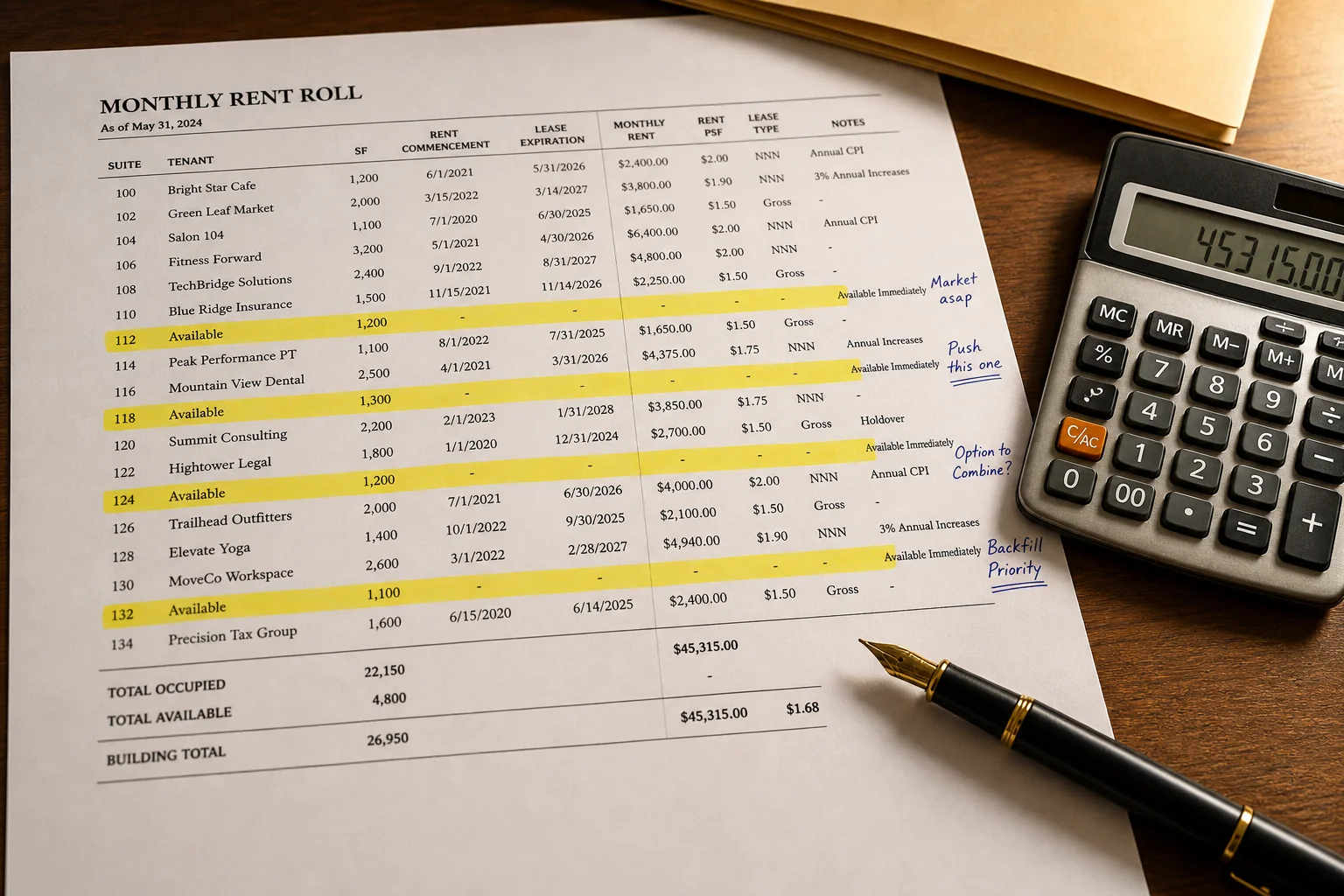
Monthly reporting is where bookkeeping translates directly into decision-making. A well-maintained set of books produces three reports without extra effort: a profit and loss statement, a balance sheet, and a cash flow summary.
Cash flow is the most important metric in real estate investing. Gross rents minus vacancy, operating costs, debt service, and reserves equals actual cash flow. Investors who track this monthly catch problems early. A rental property running negative cash flow for two months is a signal. One running negative for six months without explanation is a portfolio management failure.
Monthly reporting also shows whether costs like maintenance are tracking in line with underwriting assumptions. A property underwritten at 8% maintenance costs but running at 15% needs attention before it surfaces as a tax-season surprise.
Tax Season Preparation Through Year-Round Records
Tax season is the most visible consequence of bookkeeping quality. Real estate investors have access to meaningful deductions: depreciation, mortgage interest, property taxes, insurance, maintenance, professional fees, and more. Claiming these accurately requires documentation that matches the books.
Investors with clean monthly records provide their CPA with a complete profit and loss statement for each property, a depreciation schedule, and a list of capital improvements. Investors without clean records spend weeks reconstructing transactions from bank statements, and the result is lower-quality filings and higher professional fees.
Year-round records also support quarterly estimated tax payments. Investors with material passive income or active participation need to project quarterly liability accurately. That projection is only reliable when the books are current.
When to Outsource Real Estate Accounting
Outsourcing property management accounting makes sense when the internal time cost of maintaining books exceeds the value of that time applied elsewhere. For many investors, that threshold arrives earlier than expected.
Specialized real estate accounting firms understand depreciation schedules, 1031 exchanges, cost segregation studies, and entity structuring in ways that general bookkeepers do not. They also work fluently across software platforms, whether a portfolio runs on AppFolio, Yardi, or QuickBooks. This specialization reduces errors, produces reports that hold up under scrutiny, and frees investors to focus on acquisitions and asset management rather than reconciling accounts.
Frequently Asked Questions
What is real estate bookkeeping for investors, and why does it matter?
Real estate bookkeeping for investors is the systematic process of recording, categorizing, and reconciling all financial transactions tied to a property portfolio. It matters because accurate books support better cash flow management, cleaner tax filings, and stronger lender relationships. Investors without consistent processes typically miss deductions and underestimate true property-level costs.
Is accounting software like QuickBooks sufficient for managing real estate finances?
For smaller portfolios, accounting software like QuickBooks handles income tracking, bank reconciliation, and basic reporting well. As portfolios grow to include multiple entities, complex depreciation, or active property management functions, most investors layer in purpose-built platforms or transition to outsourced accounting to maintain accuracy at scale.
How often should real estate investors reconcile their accounts?
Monthly reconciliation is the standard for real estate investing. Every bank and credit card account tied to investment activity should be matched against actual transactions each month. Waiting longer allows errors to compound and makes year-end tax preparation significantly more difficult and costly.
What records should investors keep for tax season?
Keep records of all rental income, operating expenses, mortgage statements, depreciation schedules, capital improvement invoices, and management fees. These documents support every deduction on Schedule E or an entity return and are required if the IRS requests documentation. Current books in accounting software are the most efficient way to maintain this record set.
When does outsourcing real estate accounting make financial sense?
Outsourcing makes financial sense when the internal time cost of managing books exceeds the cost of professional services, typically around five to ten units for active investors. It also makes sense when entity structures, partnerships, or 1031 exchange activity introduce complexity that standard DIY tools cannot handle cleanly.
Structured bookkeeping is what separates investors who grow their portfolios with confidence from those who scramble at year-end. If you are ready to put reliable systems behind your real estate investments, connect with the REA team today to get started.
Want this handled for you?
Schedule a Call