Table of Contents
- What Real Estate CPA Services Cover
- Tax Planning Strategies for Property Investors
- Cost Segregation Studies and Accelerated Depreciation
- Compliance Obligations for Real Estate Developers
- Selecting Real Estate CPA Services for Your Portfolio
- Frequently Asked Questions
- Build a Stronger Tax Strategy with a Dedicated Real Estate Accounting Team
Real estate CPA services give property investors, landlords, and developers a structured path to lower tax liability, cleaner books, and audit-ready financials. Firms that specialize in Real Estate Accounting understand the nuances of depreciation, passive activity rules, and entity structuring that generalist accountants routinely miss.
By REA Team, Property Management Experts

What Real Estate CPA Services Cover
Real estate CPA services go beyond annual tax filing. A qualified real estate CPA manages depreciation schedules, tracks capital improvements, reconciles rental income, and prepares entity-level returns for LLCs, S-corps, and partnerships. For investors holding multiple properties, that breadth of expertise translates directly to protected cash flow and reduced exposure during audits.
The services real estate accounting firms deliver include both compliance and forward-looking planning:
- Federal and state income tax preparation for all property-related entities
- Depreciation analysis under MACRS and bonus depreciation rules
- Passive activity loss tracking and carryforward management
- 1031 exchange coordination with qualified intermediaries
- Quarterly estimated tax payments calibrated to actual rental income
Real estate developers have additional needs: job cost accounting, draw schedules tied to construction loans, and percentage-of-completion revenue recognition. A CPA firm that works exclusively in real estate accounting knows how to align those deliverables with both GAAP and tax-basis reporting.
Tax Planning Strategies for Property Investors
Effective accounting tax strategy for rental property owners starts well before December 31. The most impactful levers available to property investors are entity structuring, timing of deductions, and depreciation optimization.
Entity selection shapes how rental income is taxed. A single-member LLC taxed as a sole proprietor faces self-employment tax on active income, while an S-corporation election can separate reasonable compensation from pass-through distributions, often lowering the overall rate. A real estate CPA models these scenarios with actual projected income before recommending a structural change.
Timing of repairs versus capital improvements is one of the most contested areas in real estate tax. The IRS tangible property regulations, released in final form in 2013 and clarified through subsequent guidance, draw a clear line between deductible repairs and capitalized improvements. A CPA who tracks this correctly keeps deductions in the current year rather than spreading them across depreciable lives of 15 to 39 years.
Cost Segregation Studies and Accelerated Depreciation
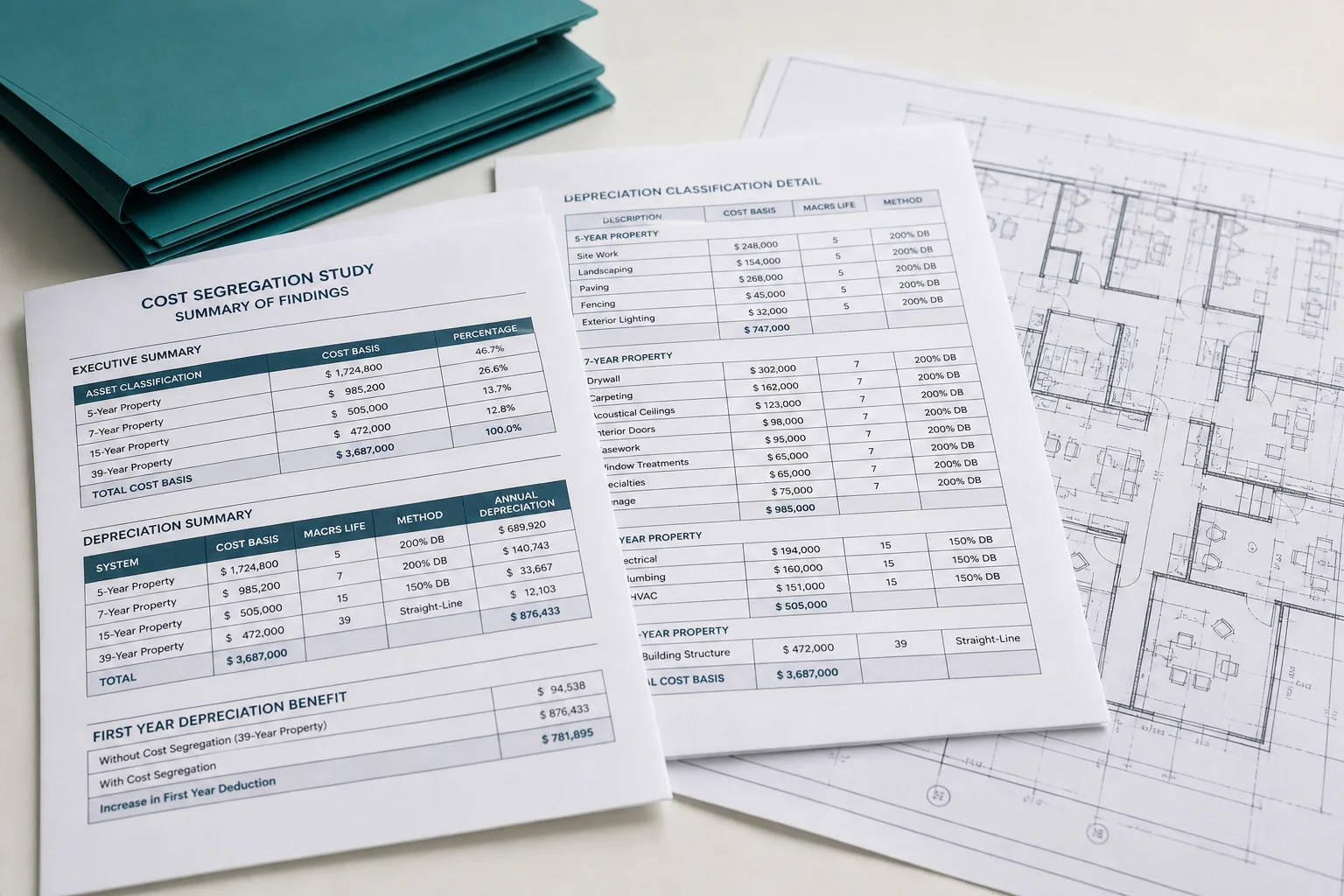
Cost segregation is one of the highest-return strategies available to property investors and real estate developers. Cost segregation studies reclassify components of a building from 27.5-year or 39-year depreciation into 5-year, 7-year, or 15-year personal property and land improvement categories. The result is a front-loaded deduction that improves cash flow in the early years of ownership.
According to the American Institute of CPAs (AICPA) guidance on cost segregation, studies must be prepared by a qualified engineer or CPA with engineering expertise to withstand IRS scrutiny. A properly documented cost segregation study for a $2 million commercial property can generate substantial accelerated deductions in year one, depending on property type and construction date.
Cost segregation studies also integrate with bonus depreciation rules. Under the Tax Cuts and Jobs Act of 2017 (TCJA), assets with a depreciable life of 20 years or fewer qualify for bonus depreciation, which was 100% through 2022 and phases down by 20 percentage points per year through 2026. A real estate CPA calculates the optimal combination of cost segregation and bonus depreciation for each property and holding period.
Real estate accounting services that include cost segregation coordination are particularly valuable for investors who recently acquired or constructed properties, since studies can also be done retroactively using a look-back method under Rev. Proc. 2002-9.
Compliance Obligations for Real Estate Developers
Real estate developers face a distinct compliance profile compared to passive landlords. Development projects generate income at different stages: land acquisition, construction, lease-up, and disposition. Each stage carries different tax treatment and reporting requirements.
The percentage-of-completion method applies to long-term construction contracts under IRC Section 460. Developers must recognize income as a percentage of estimated total contract costs incurred, which requires accurate job cost tracking. A real estate accounting firm that works with developers maintains separate cost centers for each project and reconciles them to the draw schedule monthly. That kind of cost tracking is part of a broader project accounting framework covering reporting periods and revenue recognition across the full development cycle.
Income Tax Services structured specifically for developers include cost allocation studies, state and local tax nexus analysis for multi-state projects, and coordination with legal counsel on installment sale elections at disposition.
Developers selling to institutional buyers or REITs also need audited financial statements prepared under GAAP, which requires a CPA firm capable of both tax and attestation work. Institutional buyers and REIT sponsors carry their own investor reporting and distribution obligations, so the financial package a developer delivers at disposition has to satisfy the buyer's compliance requirements as well as the developer's own tax filings.
Selecting Real Estate CPA Services for Your Portfolio
When comparing real estate CPA services providers, the key differentiators to evaluate are software platform fluency, entity complexity experience, and the ability to integrate with property management systems without rebuilding the chart of accounts from scratch.
Firms that specialize in real estate accounting services typically work within platforms like AppFolio, Yardi, or QuickBooks and can pull reports directly without manual re-entry. That integration eliminates reconciliation errors and gives investors real-time visibility into property-level cash flow.
Investors evaluating their options should run a structured due-diligence checklist covering licensing, specialty depth, and turnaround standards before signing an engagement letter.
Investors with portfolios that include mixed-use assets face an added layer of complexity: cost allocations, depreciation schedules, and even expense categorization often need to be split across the residential, commercial, and retail components of a single structure. A real estate CPA who understands mixed-use accounting keeps those allocations defensible rather than lumping the entire property into one depreciation category.
Frequently Asked Questions
What is the difference between a real estate CPA and a general CPA?
A real estate CPA specializes in property-specific tax code: depreciation under MACRS, passive activity loss rules, 1031 exchanges, cost segregation, and entity structuring for rental portfolios. A general CPA handles these areas at a surface level but may miss strategies that require deep familiarity with real estate accounting services and current IRS guidance specific to property investors.
When should a property investor hire a real estate CPA?
The best time is before acquiring a property, not after. A real estate CPA can model entity structure, estimate after-tax cash flow, and flag depreciation opportunities at the deal stage. Waiting until tax season means leaving strategies on the table that can only be implemented prospectively, such as a cost segregation study ordered before the first full tax year of ownership.
How do cost segregation studies affect taxable income?
Cost segregation studies reclassify building components from long-life categories (27.5 or 39 years) into shorter-life categories (5, 7, or 15 years), which accelerates depreciation deductions into earlier tax years. Combined with bonus depreciation under the TCJA, a study can convert a substantial portion of acquisition cost into a current-year deduction, reducing taxable income and improving cash flow in the near term.
Are real estate accounting services fees tax deductible?
Yes. Accounting and tax preparation fees directly related to rental properties are deductible as ordinary and necessary business expenses under IRC Section 162. Fees allocated to investment advice rather than property management may be treated differently under the TCJA, which suspended miscellaneous itemized deductions through 2025, so proper fee allocation and documentation are essential.
What compliance filings do real estate developers need each year?
Real estate developers typically file federal partnership or corporate returns (Form 1065 or 1120-S), state income and franchise tax returns in every state where a project is located, and 1099 forms for contractors and vendors. Projects with institutional investors may also require audited GAAP financials, quarterly investor reports, and distributions reconciled to the operating agreement.
Build a Stronger Tax Strategy with a Dedicated Real Estate Accounting Team
Specialized real estate CPA services close the gap between what you owe and what you legally must pay, keeping your books audit-ready at every stage of the investment cycle. If your current accounting tax and compliance setup is not capturing cost segregation, entity-level planning, and proper reporting for each property, Lets Connect to discuss your portfolio and identify where the gaps are.
Want this handled for you?
Schedule a Call