
Table of Contents
- Core Services in Commercial Real Estate Accounting for Boston Properties
- CAM Reconciliation and Lease Administration
- Financial Reporting and Month-End Close
- Accounts Payable, Receivable, and Vendor Management
- Common Accounting Challenges in Boston's Commercial Market
- Multi-Entity Ownership Structures
- Acquisition Due Diligence
- Tenant Improvement and Construction Accounting
- Rental Income Tracking Across Complex Lease Structures
- Technology Platforms in Boston Commercial Real Estate Accounting
- Tax Planning for Boston and Cambridge Commercial Properties
- Frequently Asked Questions
- Get Professional Support for Your Boston Commercial Portfolio
Commercial real estate accounting in Boston requires expertise that generalist firms rarely carry. CAM reconciliations, triple-net lease tracking, multi-entity financial reporting, and Massachusetts tax planning are standard requirements for office, retail, and industrial assets. Property managers and investors across the Boston MA metro rely on specialized Real Estate Accounting services to keep their portfolios financially precise.
By REA Team, Property Management Experts

Boston's commercial real estate market operates at a scale and complexity that requires accounting professionals with direct industry experience. The metro area includes high-value commercial corridors along Boylston Street Boston MA, Tremont Street Boston, and Commonwealth Avenue Boston MA, with additional concentration in Cambridge MA around Kendall Square and Central Square. Institutional owners, regional property management companies, private developers, and individual investment groups all share this market, each with distinct reporting requirements.
Standard accounting firms manage general ledger work but rarely maintain the vertical depth required for commercial real estate. Operating expense reconciliations, percentage rent calculations, tenant improvement allowance tracking, capital reserve accounting, and ASC 842 lease accounting are all standard in commercial real estate accounting but uncommon in general practice. The Financial Accounting Standards Board (FASB) established ASC 842 in 2016, requiring all entities to record lease obligations on the balance sheet. For commercial real estate portfolios with multiple tenant leases, this standard created new disclosure requirements that many generalist firms were not prepared to handle accurately.
Property managers and investors looking for reliable commercial real estate accounting in Boston need a team that understands these processes at the transaction level, not just the summary level. The cost of relying on a generalist firm typically shows up at year-end: CAM billings go unchallenged, rent abatements are missed, and reconciliations require costly corrections that could have been avoided with specialized accounting from the start.
Core Services in Commercial Real Estate Accounting for Boston Properties
Commercial Real Estate accounting services cover a defined set of functions that keep Boston properties financially accurate and auditable.
CAM Reconciliation and Lease Administration
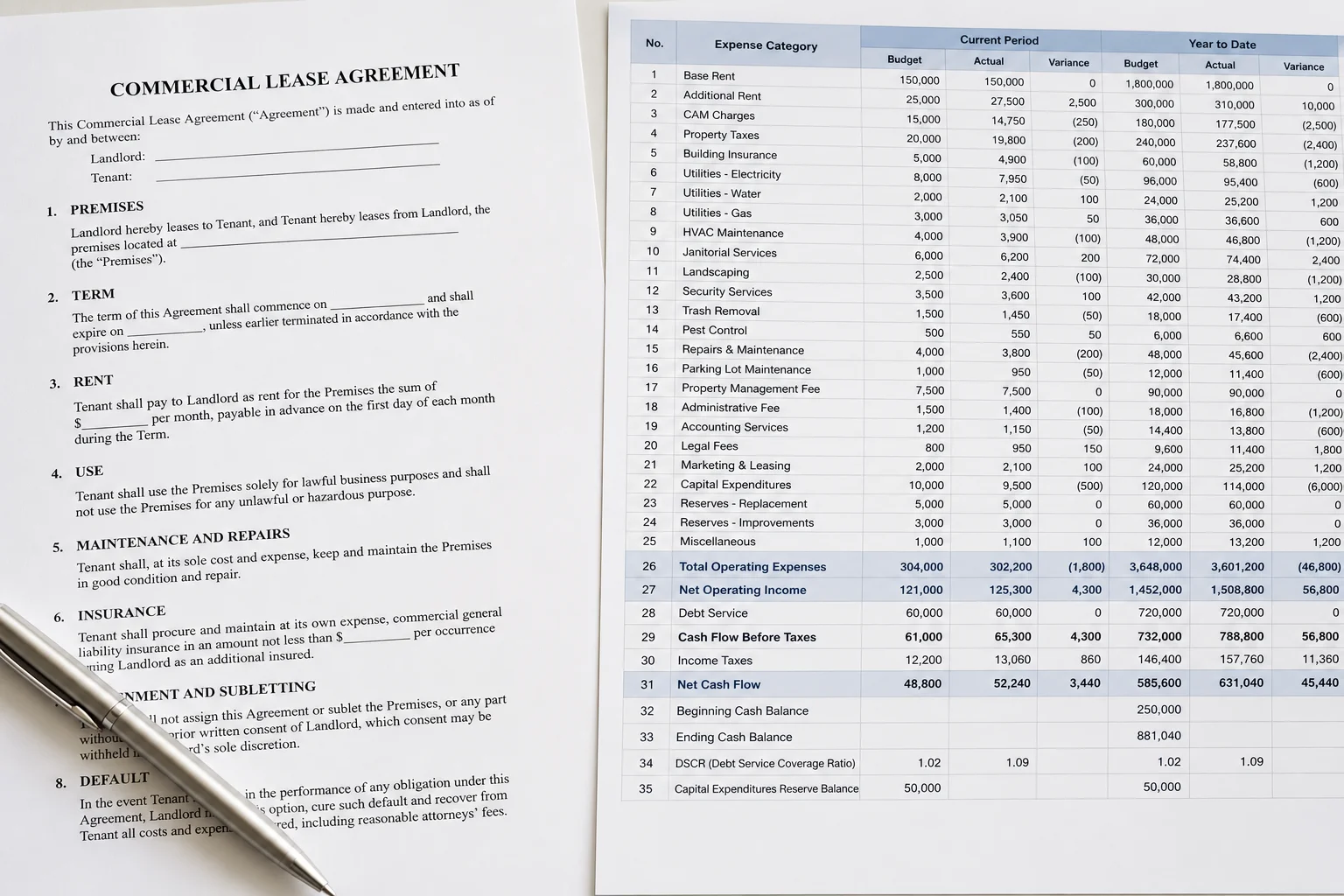
Common area maintenance reconciliation is one of the most detailed processes in commercial property management. For office buildings near St Boston MA addresses or retail properties in Cambridge, this process compares actual operating expenses against tenant estimates paid throughout the year. Each reconciliation requires invoice-level documentation, expense categorization by cost pool, and tenant-specific carve-out tracking consistent with lease language. Inaccurate reconciliations produce disputed charges, strained tenant relationships, and in some cases legal disputes that take months to resolve.
Lease administration runs alongside reconciliation, tracking rent escalation clauses, operating expense stops, tenant improvement allowances, percentage rent provisions, and renewal options across a building's full tenant roster. In a commercial building on a high-traffic Boston street, lease administration must stay current with every new deal, renewal, and modification.
Financial Reporting and Month-End Close
Commercial investors and institutional fund managers require GAAP-compliant financial statements on a consistent monthly schedule. This includes income statements, balance sheets, rent rolls, and budget-to-actual variance reports. The month-end close process covers bank reconciliation, accrual posting, intercompany entries, and final statement delivery. For properties reporting to outside investors or lenders, accuracy and on-time delivery are baseline expectations.
Accounts Payable, Receivable, and Vendor Management
Managing vendor payments for a Boston commercial property means tracking HVAC service contracts, elevator maintenance, janitorial agreements, insurance premiums, and property tax payments accurately and on time. On the receivable side, rent collection, late-fee assessment, tenant statement preparation, and security deposit accounting all require precise tracking. For a commercial building with multiple tenants at a Boston MA address, a single billing error can cascade across multiple ledger accounts.
Common Accounting Challenges in Boston's Commercial Market
Boston's commercial real estate market creates accounting challenges that firms in less complex markets rarely encounter with the same frequency.
Multi-Entity Ownership Structures
Large commercial portfolios in Boston typically involve multiple holding companies, SPEs, and operating partnerships. Intercompany transactions between these entities require careful accounting to prevent double-counted revenue and misallocated expenses. Standardized elimination entries and clear ownership documentation keep this intercompany accounting structure audit ready as a portfolio grows.
Acquisition Due Diligence
When Boston commercial properties change hands, clean historical financials directly affect lender underwriting decisions and buyer confidence. Accounting irregularities discovered during due diligence delay closings and reduce valuations. An estate agent or broker facilitating the transaction can only present the property as accurately as the underlying financial records allow. Reviewers typically flag unreconciled CAM billings, inconsistent rent rolls, and undocumented lease modifications as due diligence red flags before a deal closes.
Tenant Improvement and Construction Accounting
Boston's active development environment means tenant improvement and renovation activity at existing commercial properties is common. Tenant improvement allowances and capital expenditures must be correctly capitalized versus expensed under GAAP. Misclassifying these items distorts net operating income and affects lender calculations and property valuations.
Rental Income Tracking Across Complex Lease Structures
Commercial rental income is not always straightforward. Percentage rent, base rent, and reimbursement income from operating expense recoveries each carry different accounting treatments. Tracking rental income correctly across a multi-tenant commercial building requires a system that handles these distinctions at the transaction level, not at the summary ledger level.
Technology Platforms in Boston Commercial Real Estate Accounting
Boston commercial real estate firms use enterprise-grade platforms built specifically for commercial property portfolios. MRI Software is widely used by institutional owners for its general ledger depth, budgeting module, and integrated lease management. Its CAM reconciliation tools are built for commercial lease structures, making it a strong fit for larger Boston office and retail portfolios.
Yardi serves commercial portfolios of all sizes, with modules covering accounts payable, accounts receivable, lease administration, and financial reporting in a unified environment. AppFolio, Buildium, and Rent Manager are common among mid-size property management companies operating across multiple Boston or Cambridge MA addresses, while smaller portfolios sometimes use QuickBooks with real estate-specific configuration.
As artificial intelligence becomes more embedded in financial workflows, accounting service firms are beginning to use AI-assisted tools for transaction coding, exception flagging, and reporting automation.
Tax Planning for Boston and Cambridge Commercial Properties
Commercial real estate investment in Boston carries federal and Massachusetts state tax obligations that require consistent planning throughout the year. Cost segregation studies allow commercial property owners to accelerate depreciation deductions by reclassifying building components into shorter useful life categories. On a Boston commercial acquisition, this approach can generate significant first-year deductions when coordinated with bonus depreciation rules and Section 179 elections.
Massachusetts taxes commercial real estate income, and the City of Boston assesses property taxes through its Department of Assessing using values that can shift significantly year over year. Detailed financial records support abatement applications and tax protest filings when assessed values appear overstated. Investors holding properties in qualified opportunity zones, which include several Boston and Cambridge MA neighborhoods, face additional reporting requirements that general accounting firms rarely handle with the necessary precision.
Specialized income tax services focused on real estate ensure depreciation schedules are maximized, passive activity loss rules are applied correctly, and estimated payments remain current through each quarter. Without this level of attention, investors commonly leave available deductions unclaimed, misapply depreciation, or fall behind on quarterly payments, mistakes that are far more costly to correct after the fact than to avoid from the start.
Frequently Asked Questions
What does commercial real estate accounting in Boston typically include?
Commercial real estate accounting services in Boston cover CAM reconciliation, lease administration, month-end financial close, accounts payable, accounts receivable, bank reconciliation, financial statement preparation, and tax planning support. Firms serving Boston commercial clients also manage multi-entity reporting for portfolios structured across holding companies and SPEs, with detailed documentation at every level.
How is commercial real estate accounting different from residential property accounting?
Commercial real estate accounting involves lease structures, expense recovery calculations, and tenant billing processes that residential accounting does not require. CAM reconciliations, operating expense pools, percentage rent clauses, and ASC 842 lease accounting are core commercial functions. Residential accounting focuses primarily on rent collection, security deposits, and maintenance cost tracking without the same complexity at the transaction level.
Which software platforms support commercial real estate accounting in Boston?
MRI Software and Yardi are the most common platforms among institutional commercial owners in Boston. Mid-size portfolios often use Rent Manager, AppFolio, or Buildium, while smaller operations sometimes use QuickBooks with real estate-specific configuration. The right platform depends on portfolio size, lease complexity, and the level of financial reporting required by investors or lenders.
Do Boston commercial properties need specialized accounting for state and federal taxes?
Yes. Massachusetts imposes commercial income tax obligations, and the City of Boston assesses annual property taxes that require detailed financial records to contest or appeal. Cost segregation, 1031 exchange planning, and passive activity loss rules require real estate-specific expertise. General accounting firms without commercial real estate experience frequently miss available deductions or misapply depreciation schedules.
How does lease complexity affect commercial real estate accounting service requirements?
Properties with multiple tenants, CAM cost pools, percentage rent clauses, or significant tenant improvement activity require more accounting service hours than single-tenant or net-lease properties. Portfolios spanning multiple Boston neighborhoods or including Cambridge assets often require multi-entity reporting structures, which add complexity and professional service requirements.
Get Professional Support for Your Boston Commercial Portfolio
Boston's commercial real estate market rewards financial precision. Clean books improve debt coverage ratios, support accurate valuations, and keep lenders and investors confident through every phase of ownership. To learn what professional commercial real estate accounting services look like for your Boston or Cambridge portfolio, reach out by phone or email and Lets Connect.
Want this handled for you?
Schedule a Call