Table of Contents
- Why Month-End Close Discipline Separates Reliable Books from Unreliable Ones
- Step 1: Lock the Period and Gather All Transaction Data
- What to collect before you close books
- Step 2: Reconcile Bank Accounts and Clear Outstanding Items
- Bank reconciliation sub-checklist
- Step 3: Review Accounts Payable and Accrue Outstanding Expenses
- Accounts payable close steps
- Step 4: Verify the Rent Roll and General Ledger
- Rent roll and GL verification steps
- Step 5: Finalize the Balance Sheet, Income Statement, and Cash Flow
- Balance sheet review
- Cash flow review
- Step 6: Package and Distribute Owner Financial Reports
- Owner report package components
- Frequently Asked Questions
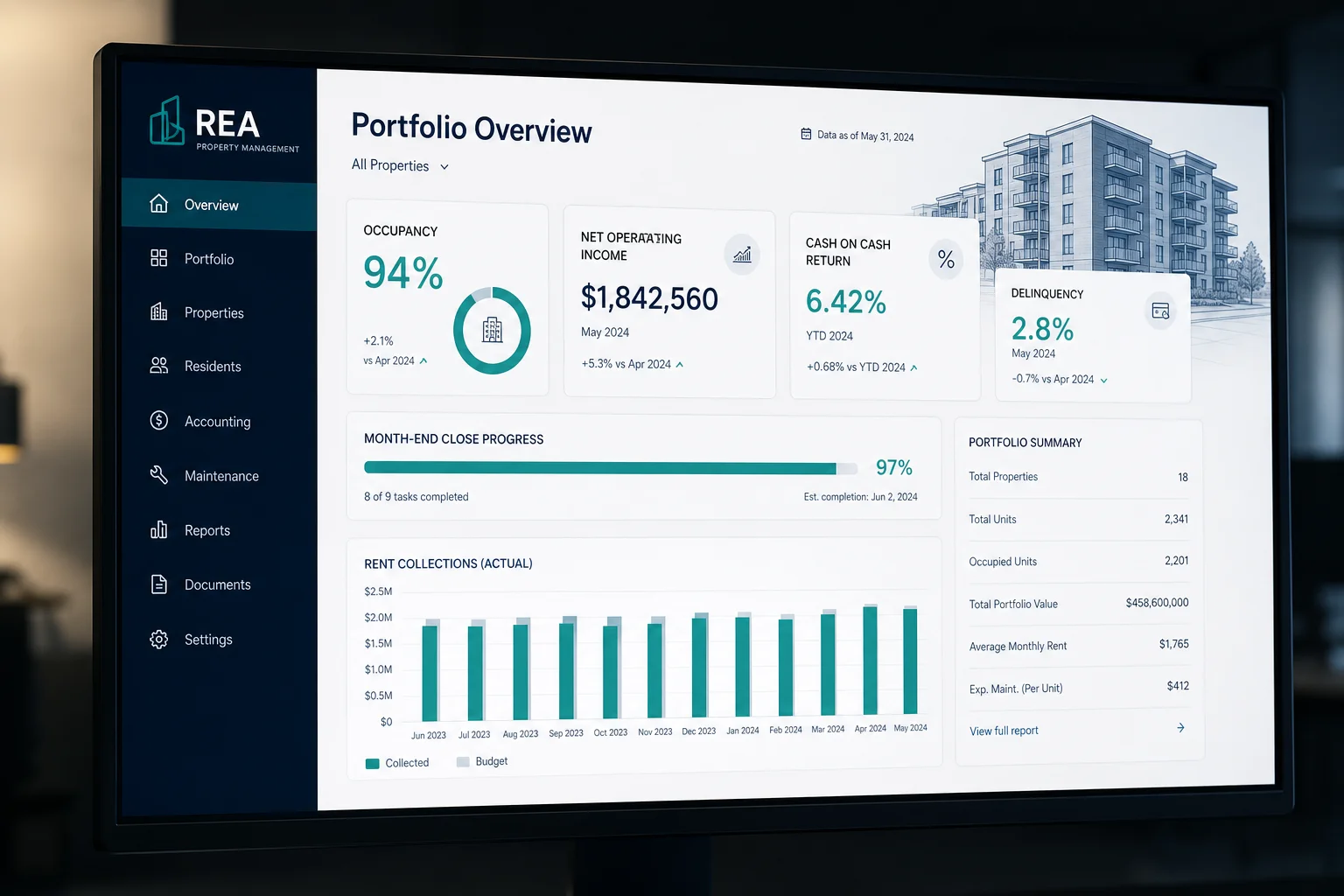
A monthly close checklist for property management companies gives accounting teams a repeatable framework to reconcile accounts, verify rent rolls, and finalize financial statements on schedule. Property managers who follow a structured month-end close process reduce errors, shorten cycle times, and produce the clean data that ownership decisions depend on.
Why Month-End Close Discipline Separates Reliable Books from Unreliable Ones
For real estate firms managing dozens or hundreds of units, the month-end close is not just a bookkeeping ritual. It is the mechanism that converts raw transaction data into accurate financial reporting that owners, lenders, and auditors rely on. Research published in the Journal of Real Estate Finance and Economics (Benjamin, Chinloy, and Jud, 2004) identified information asymmetry between property managers and investors as one of the primary sources of friction in real estate capital markets. A disciplined close process reduces that friction by producing timely, verifiable statements every period.
When property management accounting teams skip steps or rush the close, errors compound. A misposted rent payment distorts the rent roll. An unrecorded vendor invoice understates accounts payable. Both errors feed downstream into the balance sheet and cash flow reports that owners depend on for distribution decisions and lender reporting. Building a standardized month-end close checklist eliminates reliance on institutional memory and makes the process auditable by any member of the team, regardless of who performed the close that month.
Firms that close books consistently by a fixed target date also earn stronger credibility with institutional investors, who view timely financial reporting as a proxy for operational competence across the portfolio.
Step 1: Lock the Period and Gather All Transaction Data
The first action every month-end close checklist should include is a hard period lock. Before any reconciliation begins, the accounting team must confirm the cutoff date so that no new transactions post to the closing period after review has started.
What to collect before you close books
- All rent payment records from your property management platform, whether AppFolio, Yardi, Buildium, Entrata, or Rent Manager
- Vendor invoices received and processed during the month
- Bank and credit card statements for every property operating account and reserve account
- Payroll records, management fee calculations, and owner draw requests
- Capital expenditure receipts that need to be capitalized rather than expensed
- Any journal entry documentation from prior-period adjustments that carry into the current close
Locking the period early prevents retroactive postings that force restatements and create confusion across the general ledger. Most property management platforms allow date-range locks at the property or portfolio level. Establishing a consistent lock date, typically the second or third business day after month end, gives the team a clear boundary to work from.
Step 2: Reconcile Bank Accounts and Clear Outstanding Items
Bank reconciliation is the spine of any month-end close process. Every bank account tied to a property or portfolio must be reconciled to zero before the books can be considered closed. Skipping this step, or leaving unresolved items open and closing anyway, produces a general ledger that does not reflect actual cash positions.
Bank reconciliation sub-checklist
- Download the official bank statement for the close period.
- Match each deposit to a corresponding rent payment or other receipt in the general ledger.
- Match each cleared check or ACH to the corresponding vendor payment or owner distribution.
- Identify outstanding checks older than 60 days and flag them for follow-up or void.
- Record any bank fees, interest income, or returned items not yet posted.
- Confirm the reconciled balance matches the bank statement ending balance.
- Run a separate reconciliation for each operating account, security deposit account, and reserve account.
Commingling funds across entities is both an accounting error and a compliance risk for real estate operators. Each legal entity in the portfolio should have its own dedicated accounts, and each account requires its own reconciliation before the period closes. Property managers overseeing multi-entity portfolios should build entity separation into the close checklist as a hard gate, not an optional review.

Step 3: Review Accounts Payable and Accrue Outstanding Expenses
Accounts payable accuracy is critical for real estate firms because unpaid vendor invoices directly affect net operating income calculations and owner distributions. The month-end close checklist must require a complete accounts payable review before books are finalized.
Accounts payable close steps
- Pull an open AP aging report and verify that every invoice in the system has been approved and coded to the correct property and expense category.
- Accrue any vendor invoices received but not yet entered so that expenses match the period they belong to, not the period the invoice arrives.
- Confirm that recurring contracts such as landscaping, utilities, and maintenance have been posted even if the invoice has not yet arrived.
- Verify that no duplicate invoices were processed during the month. Duplicate payments are among the most common and most expensive errors in accounts payable workflows, according to research published in the Journal of Accountancy (Regan, 2018).
- Reconcile the accounts payable subledger balance to the accounts payable line on the balance sheet.
Accrual-based accounting requires that expenses be recognized in the period they are incurred, not when they are paid. Failing to accrue at month end produces financial statements that understate liabilities and overstate income, which misleads owners and can create tax compliance problems during year-end reconciliation.
Step 4: Verify the Rent Roll and General Ledger
The rent roll is the master record of every active lease, monthly charge, and payment status across the portfolio. Before you close books, the rent roll must reconcile to the general ledger without exception.
Rent roll and GL verification steps
- Export the rent roll as of the last day of the month and confirm total scheduled charges match total posted charges in the general ledger.
- Review all delinquent balances and confirm that late fees, if applicable, were posted correctly per each lease agreement.
- Verify that move-ins and move-outs processed during the month are reflected with correct proration calculations.
- Confirm security deposit liabilities in the general ledger match the sum of deposits held on the rent roll.
- Review any prepaid rent to ensure it is recorded as a liability, not income, and will release to revenue in the correct future period.
- Check that management fees, leasing commissions, and other revenue splits were calculated on the correct gross rent figures.
The general ledger is the authoritative record for all downstream financial reporting. Any discrepancy between the rent roll and the GL must be researched and corrected before the period is closed. Leaving open items and closing anyway creates a compounding problem that grows harder to unwind with each subsequent month, particularly at year-end when tax schedules are prepared.
Step 5: Finalize the Balance Sheet, Income Statement, and Cash Flow
Once bank accounts, accounts payable, and the general ledger are reconciled, the accounting team can finalize the core financial statements. For real estate accounting purposes, the three essential reports are the balance sheet, the income statement, and the cash flow statement.
Balance sheet review
The balance sheet must balance. Total assets must equal total liabilities plus equity at the close date. Common balance sheet errors in real estate accounting include security deposit liability not matching the deposit bank account balance, prepaid expenses not being amortized correctly over the applicable period, loan balances not reflecting the most recent amortization schedule, and depreciation not posted for the period.
Cash flow review
The cash flow statement reconciles net income to actual cash movement. For real estate operators, cash flow is often a more reliable performance metric than net income because depreciation, amortization, and non-cash items distort the income statement. Review the cash flow report for operating cash inflows such as rent collections versus outflows such as vendor payments and payroll, capital expenditure items properly categorized as investing activities, and loan draws or repayments classified as financing activities.
Step 6: Package and Distribute Owner Financial Reports
The final step in a complete month-end close checklist is delivering financial reports to property owners and investors. Financial reporting quality is a direct signal of accounting team competence, and late or inaccurate reports erode owner confidence in ways that are difficult to recover.
Owner report package components
- Income statement for each property and for the consolidated portfolio
- Balance sheet as of the close date
- Cash flow statement or owner cash flow summary
- Bank reconciliation reports where required by ownership agreements
- Rent roll with delinquency detail
- Capital expenditure summary if applicable
- Variance commentary explaining significant differences from prior month or budget
Most property management platforms can generate these reports automatically once the books are closed. The key discipline is reviewing each report before distribution to confirm figures are consistent across statements and that there are no obvious anomalies. Distributing an owner statement where income statement revenue differs from the rent roll total is a trust-damaging error that a pre-distribution checklist step would catch in minutes.
If your team is consistently missing close deadlines or distributing reports with errors, it may be time to evaluate whether your current workflow and staffing are appropriate for the scale of your portfolio.
Frequently Asked Questions
How long should the month-end close process take for a property management company?
For a portfolio managed with modern software, a well-staffed accounting team should complete the full month-end close process within five to ten business days after the period ends. Portfolios with complex ownership structures or mixed-use assets may require additional time. Outsourced accounting teams often shorten this cycle by dedicating staff exclusively to close tasks without the competing priorities that slow in-house teams.
What is the biggest mistake property managers make during the month-end close?
The most common error is skipping bank reconciliation or leaving unresolved reconciling items open and closing the books anyway. This produces a general ledger that does not reflect actual cash positions, which leads to inaccurate financial reporting and owner statements that cannot be trusted. Every reconciling item should be investigated and resolved before the period closes.
Do property management companies need accrual-based accounting?
Most lenders, institutional investors, and tax advisors require accrual-based financial statements for any real estate portfolio of meaningful scale. Accrual accounting recognizes revenue when earned and expenses when incurred, which produces a more accurate picture of performance than cash-basis reporting. This distinction matters most at month-end close when unpaid invoices and uncollected rents must be properly classified on the balance sheet.
Can property management software automate the month-end close checklist?
Platforms like AppFolio and Yardi include built-in close checklists, automated bank feed reconciliation, and financial reporting templates that reduce manual steps significantly. However, software does not eliminate the need for human review. Automated bank feeds can pull incorrect transactions, and coding errors still require a trained accountant to identify and correct before books are finalized and owner reports are distributed.
How does outsourced accounting affect the close timeline for property managers?
Outsourced real estate accounting firms specializing in property management typically operate with dedicated close teams that work to a fixed delivery schedule. This produces more consistent close timelines than in-house teams where turnover or competing priorities push close dates back. Outsourced providers also bring cross-platform expertise in AppFolio, Yardi, and other systems, which reduces errors from incorrect software configuration.
A consistent month-end close checklist is the foundation of accurate financial reporting for any property management company, and the right accounting partner makes it easier to hit your close target every month. Connect with the REA team to learn how outsourced real estate accounting can support your portfolio.
Want this handled for you?
Schedule a Call