
Table of Contents
- Illinois Trust Account Rules and Three-Way Reconciliation
- What Outsourced Accounting Services Chicago Property Managers Need Most
- In-House Accounting vs. Outsourced: What Chicago PM Firms Actually Spend
- Selecting the Right Accounting Firm for Your Chicago Real Estate Portfolio
- Frequently Asked Questions
- Work with a Chicago Property Management Accounting Specialist
Outsourced accounting for property management companies in Chicago gives Property Management firms a reliable path to Illinois-compliant books, timely owner disbursements, and accurate trust account records without carrying the full cost of an in-house accounting team. For Chicago property managers operating across competitive multifamily and mixed-use portfolios, outsourced accounting is the structural choice that scales.
By REA Team, Property Management Experts

Chicago's rental market is one of the largest in the United States. The city's residential portfolio spans two-flats in Logan Square, courtyard buildings in Lincoln Square, high-rise towers in Streeterville, and Class A mixed-use developments along the Riverwalk. Managing the accounting functions across a portfolio of that complexity demands far more than basic bookkeeping. Property managers in Chicago face Illinois-specific regulatory requirements that sit on top of standard accounting principles, and the cost of errors includes regulatory penalties, owner disputes, and audit exposure.
Property management firms that outsource their accounting functions consistently position themselves to deliver owner statements on fixed schedules, close the books on time each period, and maintain audit-ready records that do not depend on individual staff members. That consistency is what retains owner clients over multi-year relationships.
For Chicago property management firms managing 50 to 500 units, a fully staffed in-house accounting department is rarely the most efficient use of capital. A dedicated in-house property accountant's base pay in the Chicago metro market exceeds the national median, and that figure does not include benefits, payroll taxes, software licenses, or the management overhead required to supervise the role. Outsourced accounting converts that fixed cost into a predictable monthly fee tied directly to portfolio size.
Illinois Trust Account Rules and Three-Way Reconciliation
Illinois has specific statutory requirements for brokers who manage property on behalf of owners. The Illinois Real Estate License Act requires that security deposits be held in accounts separate from operating funds. Commingling security deposits with operating income is a license violation regardless of intent.
Three-way trust reconciliation is the audit standard for Illinois property managers: the bank balance, the internal book balance, and the sum of all individual owner and tenant ledgers must agree at the close of every period. Any discrepancy signals either an accounting error or a funds-management problem that requires immediate investigation and documentation.
Illinois security deposit law (765 ILCS 710) requires that deposits for residential properties with 25 or more units earn interest at a rate published annually by the Illinois Department of Financial and Professional Regulation (IDFPR). Property managers must provide written deposit receipts, disclose the depository institution, and return deposits within the statutory timeframe or face liquidated damages. Tracking these obligations across dozens or hundreds of tenants is precisely where manual processes accumulate errors.
Outsourced accounting firms that specialize in real estate accounting build these requirements into their standard close process. Every ledger is structured to support three-way reconciliation. Security deposit tracking runs through the property management software rather than spreadsheets, and interest calculations follow the current IDFPR annual rate automatically.
A consistent period-end close, covering reconciliation, accruals, and variance review in the same order every month, is what keeps owner statements defensible under audit. REA's monthly close checklist breaks that process into a repeatable sequence for property management teams.
What Outsourced Accounting Services Chicago Property Managers Need Most
The financial services and accounting services Chicago property management firms most commonly outsource fall into several core functions. Outsourcing these back-office tasks frees your team to focus on leasing, maintenance, and owner relationships while a specialized accounting firm handles the finance side.
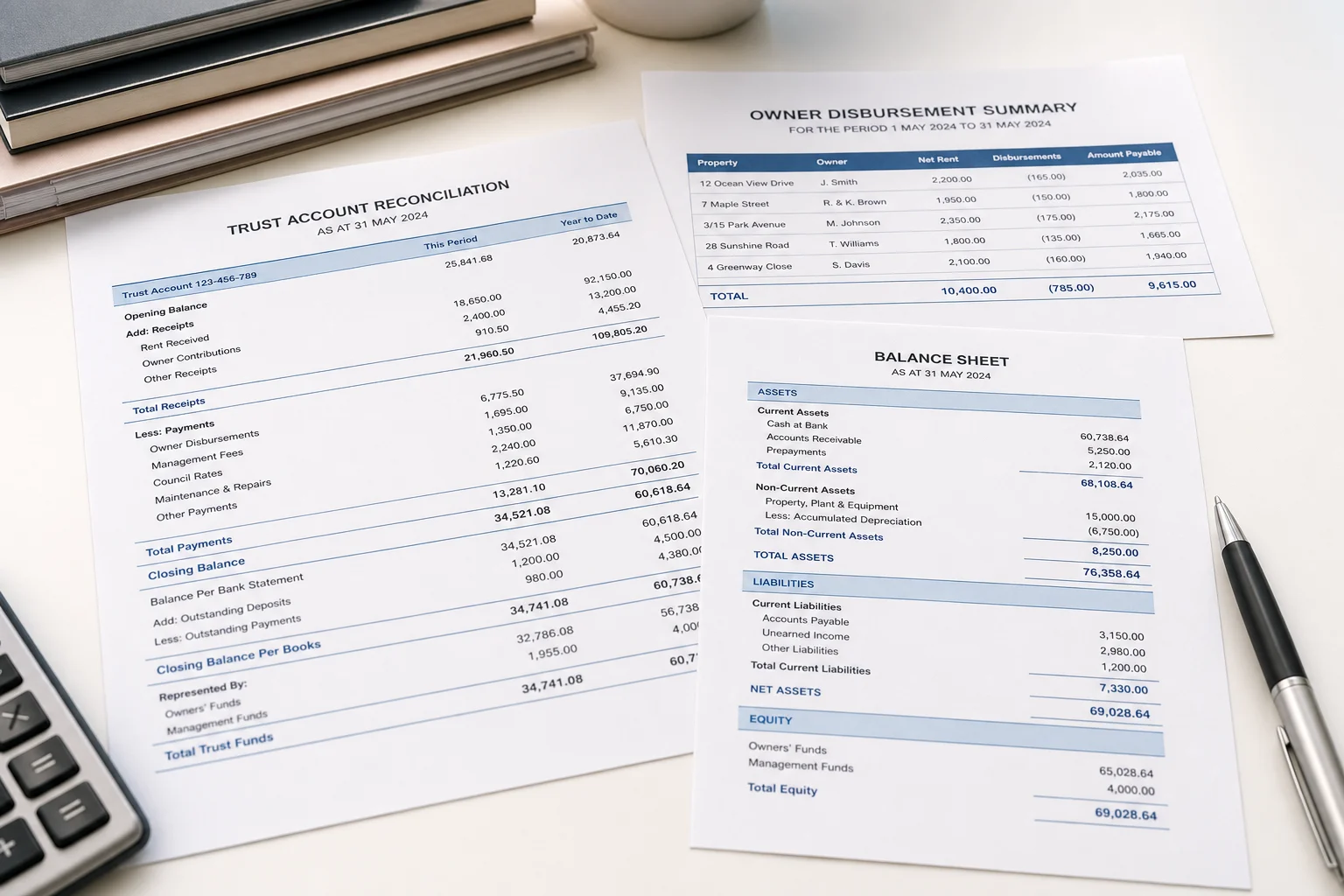
Owner statements and disbursements. Monthly owner statements should reconcile gross rents collected, vacancy loss, repair and maintenance expenses, management fees, and net proceeds available for disbursement. Outsourced teams produce these on a fixed schedule and flag variances from prior periods so owners receive clear, consistent reporting.
Accounts payable and vendor management. Chicago property management companies work with licensed contractors, HVAC vendors, landscaping crews, and building service staff. An outsourced accounting team codes invoices to the correct property and cost category, manages approval workflows, and works to ensure timely payment and avoid service interruptions.
1099 preparation and filing. The IRS requires 1099-NEC filings for any unincorporated vendor paid $600 or more annually. A portfolio of 10 properties can have 30 or more vendors requiring 1099s each year. Outsourced accounting teams maintain W-9 records throughout the year so January filing deadlines are met without a last-minute scramble.
Financial reporting and balance sheets. Investors and lenders require clean balance sheets, income statements, and rent rolls. An outsourced accounting firm produces standardized reports formatted for the property management platforms your Chicago team already uses, including AppFolio, Yardi, MRI Software, Buildium, and others.
Payroll processing. Property management companies with on-site staff, leasing agents, or maintenance personnel carry payroll obligations alongside their property accounting. Outsourced accounting teams integrate payroll processing into the general ledger so labor costs are accurately reflected in each property's financials.
In-House Accounting vs. Outsourced: What Chicago PM Firms Actually Spend
The build-versus-buy decision in accounting comes down to cost, capacity, and specialized skills. In-house accounting carries fixed costs: base pay, employer payroll taxes, health and retirement benefits, continuing education, and software licenses. Those costs persist whether the portfolio grows or contracts, and they scale awkwardly when a firm expands into a new asset class.
Benefits include direct daily access to accounting staff and full control over proprietary financial data. Firms with complex intercompany structures or regulatory reporting requirements often find that some accounting oversight remains internal even when most accounting functions outsource to a specialized partner.
Outsourced accounting shifts the cost model entirely. The fee is typically a per-unit or per-property rate, so it aligns with actual portfolio size. When a client offboards a property, the accounting cost adjusts accordingly. That alignment is difficult to replicate with in-house accounting.
The specialized skills that an outsourced accounting firm brings, including deep fluency in Illinois compliance requirements and direct experience with major property management software, take months or years to develop internally. Firms that choose outsource over in-house also reduce exposure to turnover risk: when a key in-house accounting employee leaves, institutional knowledge leaves with them. An outsourced firm provides continuity as part of its service model.
Portfolio growth past a firm's administrative capacity, the departure of a key accounting employee, and expansion into a new asset class are among the clearest signals that the switch is overdue. REA's outsourcing signs checklist lays out the full list of thresholds worth watching.
Selecting the Right Accounting Firm for Your Chicago Real Estate Portfolio
When evaluating outsourced accounting for property management companies in Chicago, not every accounting firm has the specialized knowledge the role requires. Property management companies should evaluate providers on several criteria.
Illinois regulatory fluency. The firm should understand the trust account, escrow, and security deposit rules that apply to Illinois-licensed property managers and brokers. Ask directly how their process handles three-way reconciliation and what their procedure is when a discrepancy surfaces. A standard process should ensure compliance with IDFPR requirements rather than treating compliance as a supplemental service.
Software compatibility. The firm should work natively in the platforms your team already uses. Working in a parallel system and exporting data creates reconciliation errors and reporting delays. A firm that operates directly inside your existing property management software eliminates the handoff problem entirely.
Portfolio-type experience. A firm focused on single-family rentals may not understand the accounting nuances of a 200-unit Chicago multifamily building or a mixed-use property with ground-floor commercial tenants. Confirm the firm has relevant experience with your specific asset type and deal structure.
Reporting cadence and communication standards. Chicago owners expect timely, accurate statements. Define upfront whether the firm delivers owner statements within five business days of month-end and what the escalation path is when a question arises.
Real Estate Accounting specialists at REA work directly inside the software your team already runs, meaning no data migration, no parallel systems, and no lag between your property management operations and your financial records.
Frequently Asked Questions
What accounting principles govern property management accounting in Illinois?
Property management accounting in Illinois follows generally accepted accounting principles (GAAP) as the baseline, with Illinois-specific overlays for trust account segregation, security deposit handling, and broker escrow requirements. The Illinois Department of Financial and Professional Regulation audits compliance with those requirements. An outsourced accounting firm with real estate specialization handles both layers as part of its standard engagement.
How does outsourced accounting handle trust account compliance for Chicago property managers?
A qualified outsourced accounting firm structures its monthly close to include three-way trust reconciliation as a required step. Bank balances are verified against internal books and individual ledgers at every period end. Security deposit accounts are kept separate from operating accounts, and interest calculations follow the current IDFPR rate published annually for qualifying residential properties.
What does it cost to outsource property management accounting compared to hiring in-house?
Cost varies by portfolio size and service scope, but the outsourced model converts a large fixed payroll expense into a variable fee that scales with your unit count. In-house accounting carries employer payroll taxes, benefits, software subscriptions, and management overhead on top of base pay. An outsourced firm absorbs those internal costs and charges a flat or per-unit fee.
Can an outsourced accounting firm work inside our existing property management software?
Yes, provided the firm has established expertise in the platform you use. REA's team works natively in AppFolio, Yardi, MRI Software, Buildium, and Rent Manager, among other major platforms. This means the outsourced team operates inside your existing data environment rather than running a parallel system that requires manual reconciliation.
When is the right time for a Chicago property management company to outsource its accounting?
Most firms reach the transition point between 50 and 150 units, when transaction volume outpaces what an office manager or part-time bookkeeper can reliably handle. Expansion into a new asset class, a portfolio acquisition, or the departure of a key accounting employee are also common triggers. Platform-level accounting expertise matters too: a firm that already knows the reporting and configuration details of your specific software reaches full productivity on your books faster than one still learning the platform.
Work with a Chicago Property Management Accounting Specialist
Property management companies across Chicago that need accurate financials, clean trust account records, and on-time owner disbursements without the overhead of an in-house team have a clear path forward. Lets Connect with REA's team to discuss how outsourced accounting for property management companies in Chicago fits your portfolio and what an engagement looks like from day one.
Want this handled for you?
Schedule a Call