Table of Contents
- New York Trust Account and Escrow Compliance Property Managers Can't Skip
- Owner Statements, Disbursements, and 1099 Season Done Right
- Matching Accounting Software to Your New York City Portfolio
- What Outsourced Accounting Looks Like in a New York City Case Study
- Frequently Asked Questions
- Get New York City Property Accounting Support From REA
New York City property management companies juggling trust deposits, board-approved budgets, and multifamily portfolios need outsourced accounting for property management companies in New York City that closes trust books on time, reconciles every ledger, and keeps Property Management operations audit-ready under state escrow rules.
By REA Team, Property Management Experts

New York City runs on real estate, from rent-stabilized walkups in Queens to mixed-use towers in Long Island City, and every unit generates its own trail of rent rolls, vendor invoices, and owner draws. Property management companies here are expected to deliver accurate financial reporting to boards, institutional owners, and individual investors on a monthly cycle, while also meeting the state's licensing and trust account rules for brokers who handle client funds. Building an in-house accounting services team that can keep pace with that volume, across dozens of entities and chart-of-accounts structures, is an expensive business problem and hard to staff in this market. That is why demand for outsourced accounting for property management companies in New York City keeps climbing: the work gets done by a team that already understands real estate accounting, property accounting, and the reporting cadence institutional owners expect, without the overhead of building that department from scratch.
New York Trust Account and Escrow Compliance Property Managers Can't Skip
Property managers who hold rent, security deposits, or reserve funds as licensed New York real estate brokers are subject to state real estate licensing law and Department of State trust account requirements. Client money has to sit in a dedicated trust or escrow account, fully separate from the company's operating cash, and it cannot be advanced, borrowed against, or used to cover a shortfall on another property. Examiners and owners alike expect the account to pass a three-way trust reconciliation every month: the bank statement balance has to match the book balance, and both have to equal the sum of every owner and tenant sub-ledger added together. When those three numbers do not tie out, it is usually a sign that a deposit was posted to the wrong property, a disbursement cleared before it was recorded, or a bank fee was never booked.
New York's General Obligations Law also governs how residential security deposits are handled. For buildings with six or more units, the deposit has to sit in an interest-bearing account, with interest credited or paid to the tenant, less a small administrative fee retained by the property manager or owner. Getting that wrong, even on a handful of units, creates exposure with tenants, boards, and the state alike. This is where an outsourced accounting for property management companies in New York City partner earns its keep: reconciling trust accounts line by line, flagging deposit and escrow exceptions before month end, and keeping documentation ready if a lender, auditor, or the Department of State ever asks for it. Reconciliation load that keeps climbing past what an in-house team can manage is one of several warning signs to watch for.
Owner Statements, Disbursements, and 1099 Season Done Right
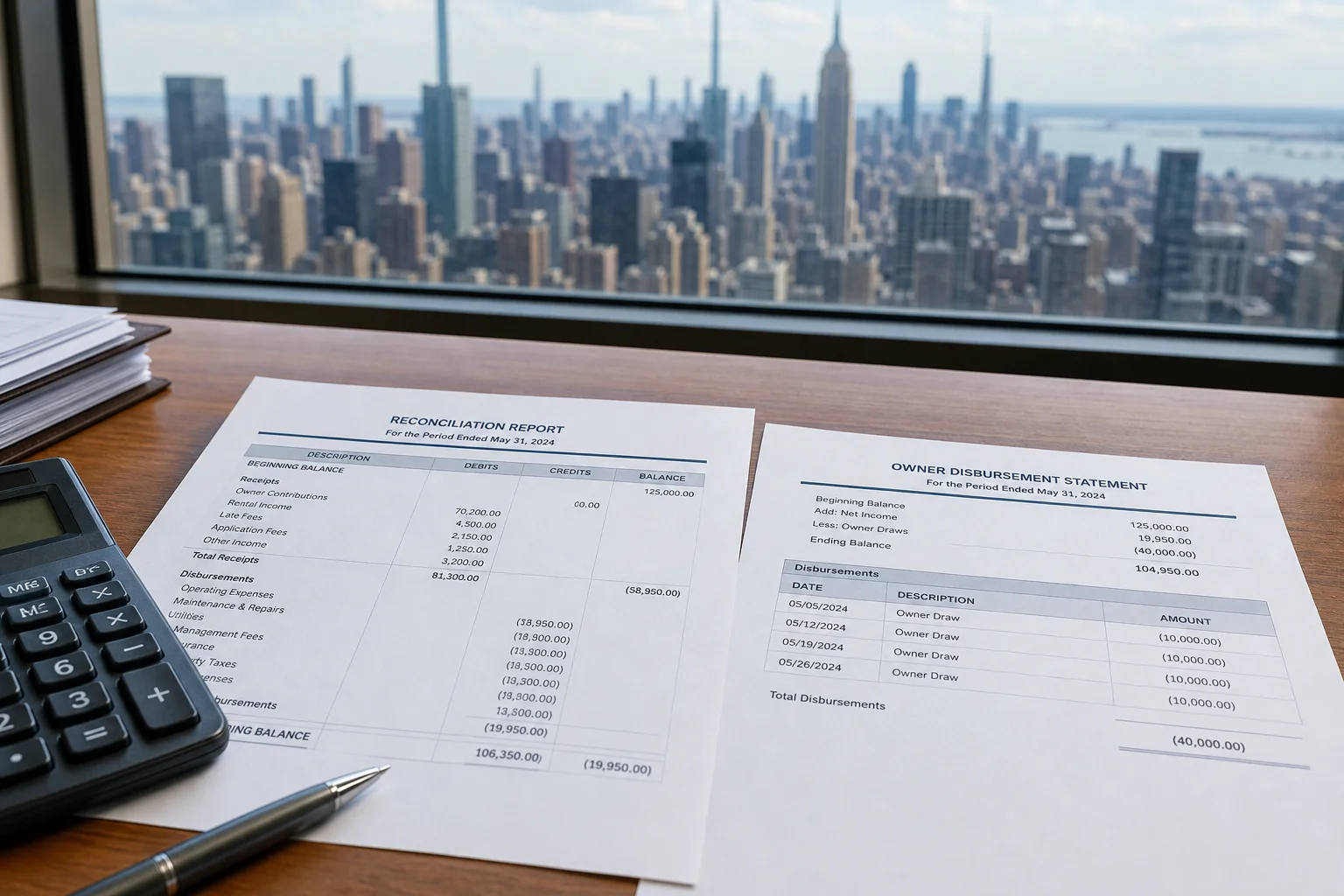
Owners and boards do not just want a number at month end, they want financial statements they can act on: a balance sheet, income statement, and cash flow summary by property, plus a disbursement schedule that shows exactly what cleared, what is pending, and why. In a market as competitive as New York City, a property management company that can turn around clean financial statements a few days faster than the last provider has a real edge when a board is deciding whether to renew a management contract.
Disbursements carry their own compliance load. Owner draws have to come out of the operating account only after trust obligations are covered, vendor payments need a clean approval trail, and management fees have to be calculated and booked consistently across every property in the portfolio. Then January arrives and every owner, along with every vendor paid past the federal threshold, needs a 1099 that matches what was actually reported all year. Outsourced accounting for property management companies in New York City works because the same team producing monthly statements also owns 1099 season, so there is no scramble to reconstruct a year of disbursements from scratch. That reporting cycle holds together only when the close runs on a fixed month-by-month cadence, the discipline we lay out in our monthly close checklist.
Matching Accounting Software to Your New York City Portfolio
Every New York City property management company runs on some combination of property management software, and the accounting workflow only works if the outsourced team is fluent in the accounting software already in place, not asking you to switch. AppFolio handles a large share of the city's mid-size residential and mixed-use portfolios well, Yardi and RealPage tend to show up on larger institutional and commercial books, and Buildium and Rent Manager are common with smaller, growth-stage management companies. QuickBooks still sits underneath the general ledger for plenty of firms too, usually synced with whichever property-level system tracks the rent roll.
The platform matters less than what happens inside it. A property accounting team needs to know how to build a chart of accounts that supports the reporting your owners actually want, set up bank feeds and reconciliation rules correctly the first time, and run month-end close on a fixed schedule instead of whenever there is time. For a growing New York City portfolio comparing Yardi and RealPage, the better fit usually comes down to scale: both platforms handle the complex, multi-entity reporting that larger institutional and commercial portfolios need, so the deciding factor is often which system your ownership group, lenders, and property teams are already built around.
What Outsourced Accounting Looks Like in a New York City Case Study
Consider a case study that is common across the city: a management company overseeing a mix of rent-stabilized multifamily buildings and a few ground-floor commercial leases, growing from a dozen properties to several dozen in under two years. Owner reporting that used to take three weeks started taking five, reconciliations fell a month behind, and the team spent more time chasing prior-period errors than closing the current financial period. Bringing in outsourced accounting for property management companies in New York City reset that cycle: a dedicated team rebuilt the trust reconciliation process property by property, cleared the reconciliation backlog within one close cycle, and had owner statements back on a fixed monthly calendar within the following quarter.
Commercial leases inside a mixed portfolio add their own layer, common area maintenance reconciliations, escalations, and percentage rent all need to flow into the same set of books as the residential side. That commercial layer runs through the same general ledger and chart of accounts as the residential side, with its own reconciliations layered on top, all under one real estate accounting program built for growth.
Frequently Asked Questions
What does outsourced accounting for property management companies in New York City actually include?
It typically covers trust account bookkeeping and reconciliation, owner and tenant ledger management, monthly financial statements, accounts payable, and 1099 preparation. Most New York City property management companies keep budgeting, board relations, and leasing decisions in-house, and lean on outsourcing for the recurring accounting services and month-end close work instead.
How does trust account reconciliation work for a New York property manager?
The team compares three numbers monthly: the bank balance, the book balance, and the total of every owner and tenant sub-ledger combined. All three have to match. When they do not, the reconciliation traces the difference to a specific deposit, disbursement, or bank entry so it gets corrected before the next month starts, not carried forward.
Can an outsourced team work inside AppFolio, Yardi, or Buildium without disrupting our current setup?
Yes. A property accounting partner should work inside whatever software your company already runs rather than requiring a migration. That means building the chart of accounts, bank feeds, and reporting templates around your existing platform, so owners and staff see no disruption to the reports or portals they already use.
How quickly can a New York City property management company switch to outsourced accounting?
Most transitions run 30 to 60 days, starting with a review of open reconciliations and prior financial statements, then a parallel close cycle before the outsourced team takes over fully. Portfolios with a large reconciliation backlog sometimes need an extra cycle to clear historical items before month-end reporting settles into a normal rhythm.
Get New York City Property Accounting Support From REA
If trust reconciliations, owner statements, or 1099 season are eating time your business should be spending on growth, Lets Connect and walk through what outsourced accounting for property management companies in New York City could look like for your portfolio.
Want this handled for you?
Schedule a Call