Table of Contents
- Why Property Management Bookkeeping Differs from Standard Accounting
- Building a Chart of Accounts for Multi-Unit Properties
- Core Bookkeeping Processes Every Property Manager Must Track
- Rent Collection and Income Recording
- Security Deposit Accounting
- Vendor Payments and Expense Allocation
- Bank Reconciliation
- Owner Disbursements and Statements
- Choosing the Right Accounting Software for Your Portfolio
- Producing Financial Reports That Owners and Lenders Trust
- Frequently Asked Questions
- Build a Bookkeeping Foundation Your Portfolio Can Grow On
Property management bookkeeping is the financial backbone of every multi-unit portfolio. Accurate records of income, expenses, and bank reconciliations give Property Management firms the clarity they need to grow, stay compliant, and protect owner returns across every property in their books.
By REA Team, Property Management Experts

Why Property Management Bookkeeping Differs from Standard Accounting
Standard business accounting tracks revenue and expenses for a single entity. Property management bookkeeping adds layers that most accounting frameworks never encounter: per-property ledgers, tenant security deposits held in trust, owner disbursements, and maintenance cost allocation across dozens or hundreds of units. Property managers who treat their books like a generic small business find that their financial reports tell an incomplete and often misleading story.
The core difference is entity separation. Every property in a portfolio functions as its own profit center. Costs and revenue must be tracked at the property level, not simply rolled up into a single company ledger. This structure is what makes management accounting in real estate meaningfully different from retail or service-sector bookkeeping.
Building a Chart of Accounts for Multi-Unit Properties
A well-structured chart of accounts is the foundation of any property management accounting system. For multi-unit portfolios, this means creating account categories that map directly to how the business earns income and incurs costs.
Typical account groups include:
- Income: Rent revenue, late fees, pet fees, parking, laundry income, application fees
- Operating Expenses: Repairs, maintenance, landscaping, utilities, insurance, property taxes
- Owner Accounts: Management fees, owner draws, reserve contributions
- Liabilities: Security deposits held, prepaid rent, loan balances
The chart accounts structure should mirror how owners expect to see reporting. If owners receive monthly statements segmented by building, the chart accounts must support that segmentation. Retrofitting an account structure after a portfolio has grown requires a full data audit and often introduces reporting inconsistencies that take months to resolve.
Real Estate Accounting specialists typically configure the chart accounts in the platform before onboarding a single property, treating it as a mandatory prerequisite. For portfolios that include retail or commercial tenants alongside residential units, income and expense accounts should be split by lease type so reporting never blends fundamentally different revenue streams, a structure covered in more depth in accounting for mixed-use properties.
Core Bookkeeping Processes Every Property Manager Must Track
Rent Collection and Income Recording
Every payment must be logged against the correct unit, tenant, and lease term. When a tenant pays late, the fee must post separately from the base rent so financial reports accurately reflect income composition. Combining rent and fee income into a single line item is a common error that distorts cash flow reporting and undermines accurate owner statements.
Security Deposit Accounting
Security deposits are liability accounts, not income. Many property managers book deposits as revenue on receipt and reverse the entry at move-out. This creates inaccurate financial statements throughout the tenancy. The correct approach is to hold deposits in a dedicated trust or escrow account and carry them as a liability until disposition.
Vendor Payments and Expense Allocation
Repair and maintenance invoices must be matched to the property where work occurred. For portfolios with shared service contracts, costs should be allocated by unit count or square footage using a consistent method applied across all reporting periods. Accurate expense tracking supports owner reporting, tax preparation, and year-end budget analysis.
Bank Reconciliation
Monthly bank reconciliations confirm that the general ledger matches actual bank activity. This step catches duplicate entries, missing deposits, and unauthorized charges before they compound. For property managers running multiple trust accounts, reconciliation must happen account by account, not as a consolidated total.
Owner Disbursements and Statements
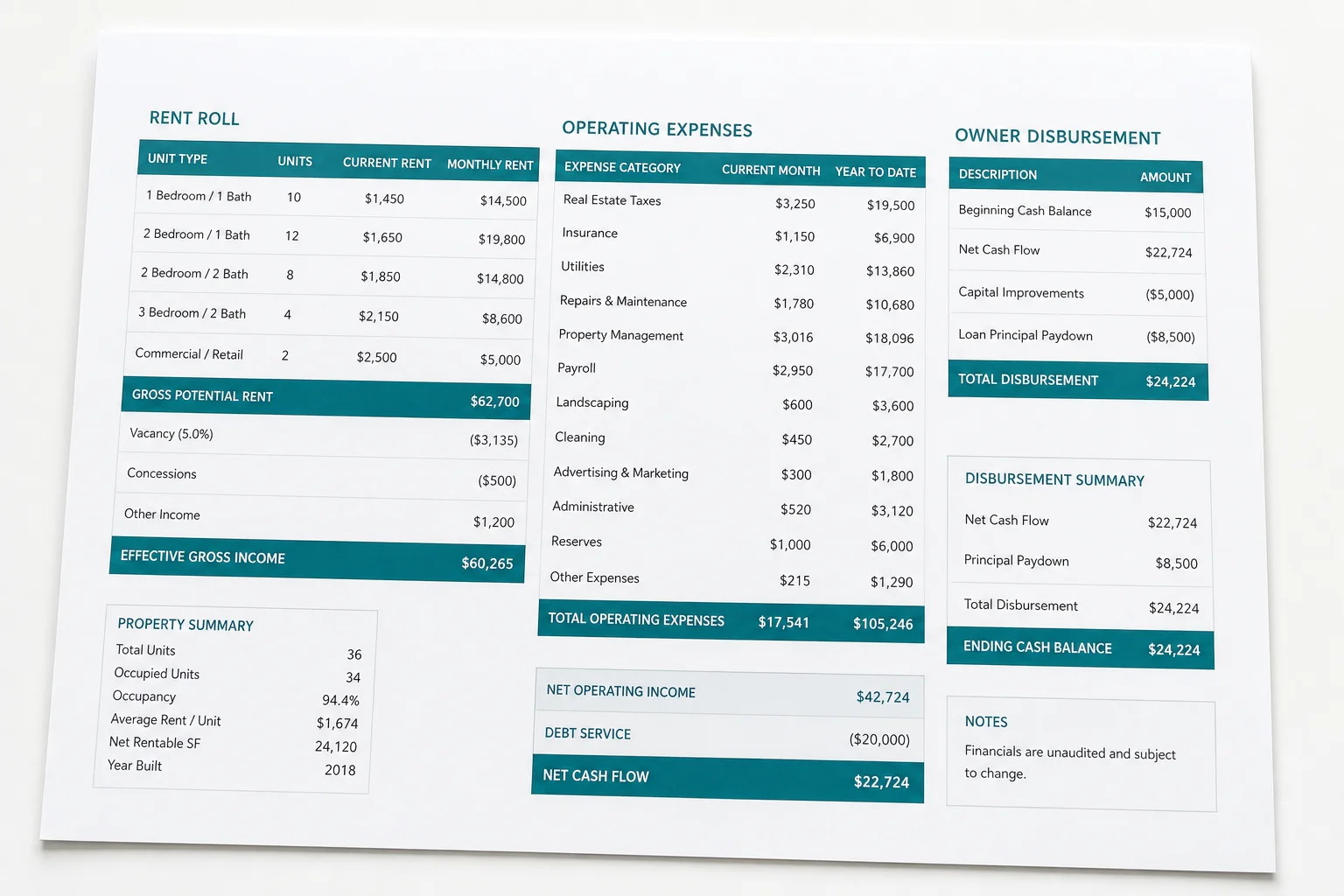
Owners typically receive a net disbursement each month after management fees, maintenance costs, and reserve contributions are deducted. The accompanying owner statement must show gross income, every expense line, the management fee, and the resulting distribution. Clear, accurate owner statements are one of the primary factors that determine whether investors stay with or leave a management company.
These same reporting principles apply directly to owners and investors evaluating portfolio performance, since accurate bookkeeping systems for investors rely on the same clean separation between income, expenses, and disbursements.
Choosing the Right Accounting Software for Your Portfolio
Property management software has become far more capable over the past decade, and the leading platforms each handle property management accounting in distinct ways. The right accounting software depends on portfolio type, reporting requirements, and team size.
AppFolio is widely used by residential property managers for its intuitive interface and built-in owner portals. Buildium offers comparable features with strong trust accounting controls that satisfy many state escrow requirements. For commercial-heavy or mixed portfolios, Yardi and MRI Software provide the depth of lease administration and financial reporting that residential-focused property management software typically lacks.
Regardless of platform, the accounting software must support per-property general ledgers, trust account management, bank feed integration for reconciliation, customizable financial reports, and 1099 generation for vendors and owners. Teams evaluating platforms should also confirm how the software handles multi-entity management, as portfolios held under multiple LLC structures require strict entity separation at the data level.
Producing Financial Reports That Owners and Lenders Trust
Financial reports are how property managers communicate portfolio health to owners, lenders, and tax advisors. The standard report set for a property management firm includes the rent roll, a property-level profit and loss statement, a balance sheet, a cash flow statement, and an owner disbursement statement.
The cash flow statement is particularly important for lenders evaluating refinancing or acquisition financing. A clean set of financial reports, produced monthly and reconciled against actual bank activity, can accelerate loan approvals and support better financing terms.
Firms considering outside support for their books should evaluate potential partners on their experience with trust accounting, familiarity with the property management software already in use, and the cadence and detail of the financial reports they produce for owners. A partner who cannot speak specifically to per-property ledgers and owner disbursement statements is not equipped to handle a multi-unit portfolio.
Frequently Asked Questions
What is property management bookkeeping?
Property management bookkeeping is the process of recording and reporting all financial transactions for a rental portfolio. It covers rent collection, expense tracking, security deposit management, bank reconciliation, owner disbursements, and production of financial reports for owners, lenders, and tax advisors. It differs from standard bookkeeping by tracking income and costs at the individual property level.
Why does the chart of accounts matter for property managers?
The chart accounts structure determines how income and expenses are categorized and reported across a portfolio. A properly built chart accounts allows property managers to produce owner statements, tax schedules, and lender reports without manual reclassification. A poorly structured chart accounts forces workarounds that introduce errors over time and make year-end tax preparation significantly harder.
Which accounting software works best for property management?
The best accounting software depends on portfolio type and scale. AppFolio and Buildium are well-suited for residential property managers. Yardi and MRI Software handle larger commercial and mixed-use portfolios. Each platform supports trust accounting, bank reconciliation, and the financial reports that owners and tax advisors require for real estate portfolios.
How often should property managers reconcile bank accounts?
Bank reconciliation should occur monthly at minimum. For firms holding tenant deposits in trust accounts, many state statutes require monthly or quarterly reconciliation of those accounts. Monthly reconciliation catches discrepancies before they affect owner statements, tax filings, or regulatory audits.
What makes property management accounting different from standard accounting?
Property management accounting requires per-property general ledgers, trust account management for security deposits, owner-specific disbursement reporting, and compliance with state escrow regulations. Standard accounting consolidates all transactions into a single entity, which does not provide the property-level transparency that real estate investors and regulators expect.
Build a Bookkeeping Foundation Your Portfolio Can Grow On
Strong property management bookkeeping protects owner relationships, supports tax compliance, and gives your team the financial clarity to scale with confidence. If you are ready to put professional accounting behind your real estate operation, Lets Connect to see how REA supports property managers at every stage of growth.
Want this handled for you?
Schedule a Call